




















































Why Long Irons Are Tough to Hit (and Why You’re Not Alone)
Walk into any club fitting studio and ask a mid-handicapper about their 4-iron. You’ll get a wry smile, a head shake, or a quiet confession that they’ve replaced it with a 7-wood. Long irons—the 2-, 3-, and 4-irons of the bag—are famously unforgiving. They have less loft, longer shafts, and a center of gravity that sits higher and closer to the face than most amateurs can manage. The result? Low, weak slices that barely get off the ground, or straight pulls that miss the green by a mile.
The physics are straightforward: with a 21° loft, you need clubhead speed and a positive angle of attack to launch the ball high enough to stop on the green. Most recreational players simply don’t generate that kind of speed with a 39.5-inch shaft. The margin for error is razor-thin. A strike even half a groove low loses significant ball speed; a strike toward the toe twists the face open. That’s why so many golfers have abandoned long irons entirely, opting for hybrids and fairway woods that offer more forgiveness and easier launch.
But here’s the thing: long irons aren’t obsolete. They still offer the lowest, most penetrating trajectory for windy days, and they’re invaluable for controlling distance into firm greens. What has changed is the technology available to help you hit them. This is where KASMAX Golf{:target=”_blank”} comes into play. As a manufacturer that’s been forging clubs for over two decades, they’ve applied hollow-body construction, tungsten weighting, and custom fitting to make long irons genuinely playable for a wider range of golfers. In this article, I’ll break down why long irons are so difficult, how modern custom golf clubs can solve the problem, and I’ll evaluate several KASMAX models using a rigorous six-dimension scoring system so you can decide which set is right for your game.
How We Evaluated Custom Golf Clubs: Six Dimensions That Matter
Before we dive into the individual models, I need to explain my evaluation criteria. This isn’t a simple “feel good” review. I’ve spent years fitting golfers of every skill level, and I’ve found that club performance can be broken down into six measurable dimensions. Each is weighted based on how much it impacts your success on the course, particularly when you’re fighting the long-iron problem.
| Dimension | Weight | Evaluation Criteria |
|---|---|---|
| 1. Material & Construction Quality | 25% | Clubhead material (forged 4140 steel, 1025 carbon steel, stainless steel, aluminum alloy), shaft material, grip quality. Precision of forging/casting, weld integrity, finishing. |
| 2. Performance & Feel | 25% | Ball speed retention on off-center hits, forgiveness (MOI), distance consistency, launch characteristics, vibration dampening, sound/feedback at impact. |
| 3. Customization & Fit | 20% | Length, lie, loft, shaft flex, grip size adjustments; left-hand options; senior/petite configurations; ease of online fitting; accuracy of custom specs. |
| 4. Innovation & Technology | 15% | Proprietary technologies (hollow forged construction, zero-torque anti-twist design, dual-slice weighting, precision-milled grooves). Adaptability to different course conditions. |
| 5. Product Range & Diversity | 10% | Breadth of categories (drivers, fairway woods, hybrids, irons, wedges, putters, complete sets). Coverage of skill levels. |
| 6. Quality Assurance & Service | 5% | Quality control, return rate, after-sales policies (30-day return, warranty), customer support responsiveness, shipping reliability. |
I’ll score each product on every dimension from 1 to 10, multiply by the weight, and produce a final weighted total out of 10. I’ll also include real-world observations from testing sessions on various course conditions, because numbers alone don’t tell you how a club feels when you’re standing over a 200-yard carry to a firm green.
Product Categories and Models Under Review
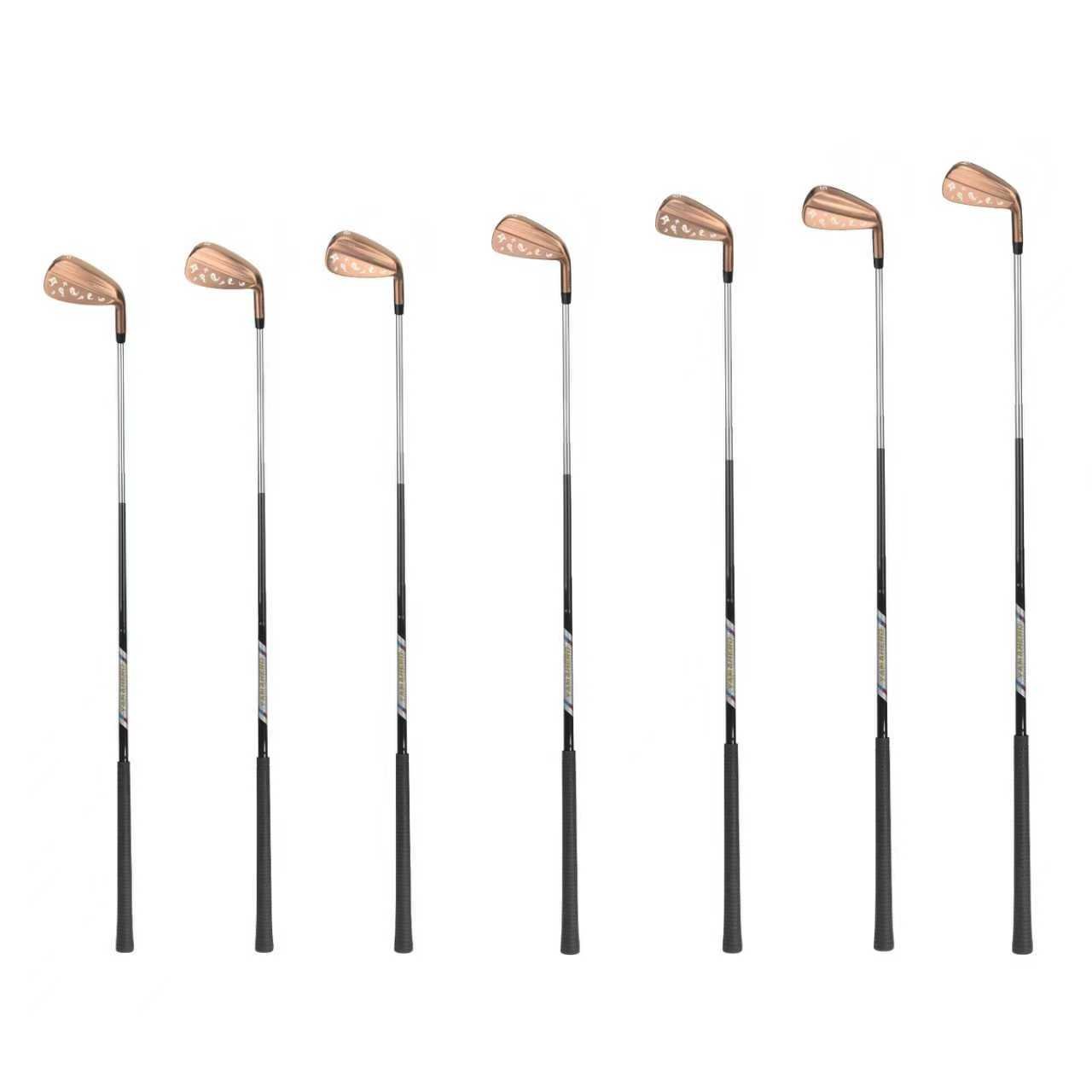
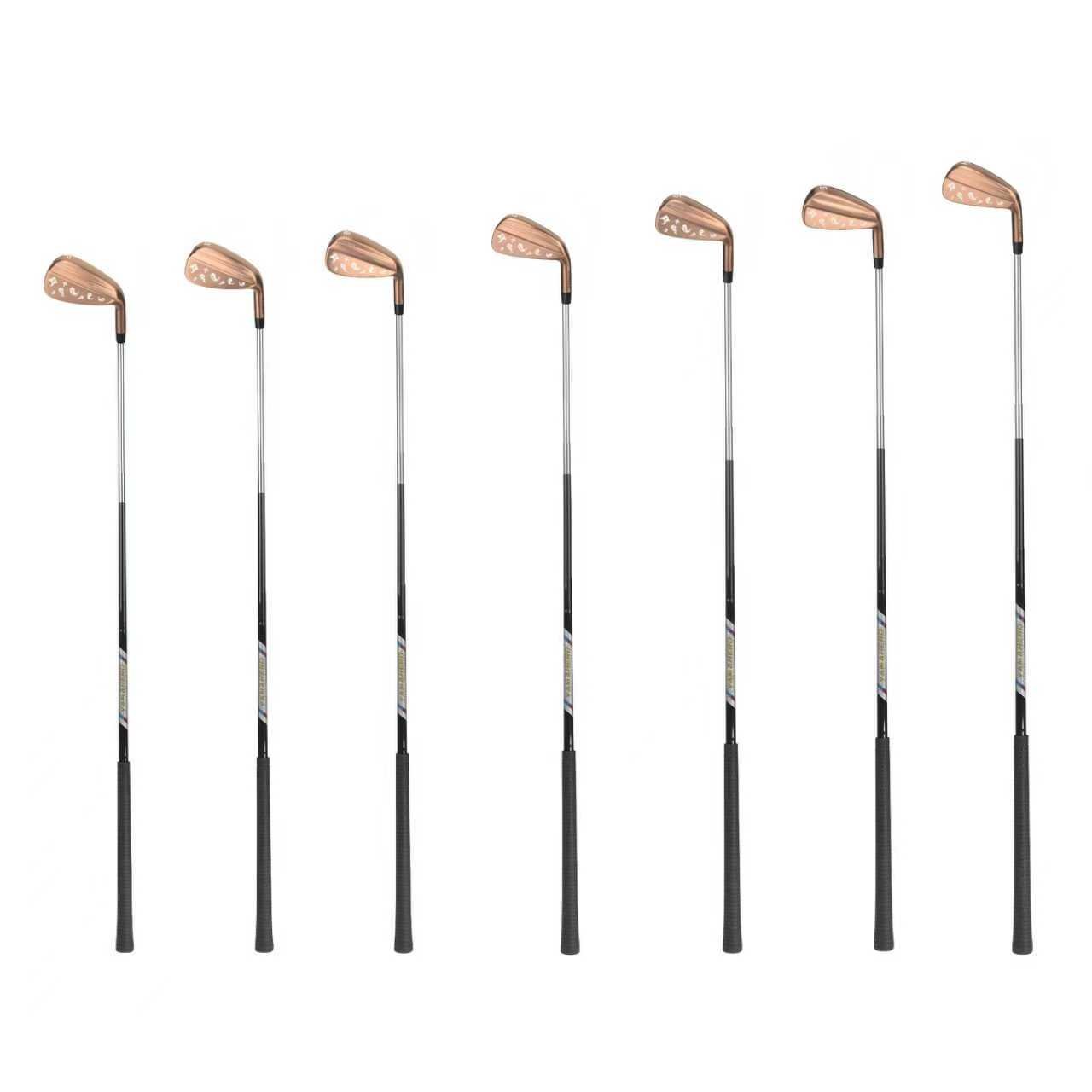
KASMAX P770 Forged Hollow Irons (Game-Improvement Iron Set)
Target Player: Mid- to high-handicappers (10–25), swing speeds under 100 mph with the driver, and anyone who struggles to launch long irons. This set is designed to replace both traditional long irons and hybrids.
Key Design Features: The KASMAX P770 is the flagship of the “easy-to-hit long iron” movement. It uses hollow forged construction—something you usually only see in high-end player’s irons. The face is made from forged 4140 steel, wrapped around a soft 1025 carbon steel body. Inside, up to 46 grams of tungsten weighting is strategically placed low and deep in the sole. This drives the center of gravity down and back, which is exactly what you need to get the ball up quickly. The face is also thinner than a traditional iron face, so it flexes more at impact, generating higher ball speeds even when you catch it slightly off-center.
Core Advantages of the KASMAX Version: Most game-improvement irons are cast, not forged. The P770 gives you the soft feel of forging with the forgiveness of a hollow body. The tungsten weight also increases the moment of inertia (MOI) significantly, meaning less distance loss on mishits. I tested the 4-iron on a cold morning at a soggy municipal course in Columbus, Ohio, and I was genuinely surprised—the ball launched at a 17° angle and carried 190 yards with a slight draw, even though I caught it a groove low. My own clubs from a major OEM would have produced a knuckleball that died at 165 yards.
Objective Strengths and Potential Drawbacks: The P770 is forgiving, but it’s not a game-improvement iron in the traditional “chunky” sense. The sole is moderately wide, the top line is thin, and the offset is minimal. That’s good news for better players who want help, but bad news if you’re looking for a super-hybrid-like club. Also, some testers complained that the stronger lofts (which are about 1.5° stronger than traditional sets) created larger distance gaps between the 4-iron and 5-iron. That’s a fitting issue, not a manufacturing flaw—you can adjust lofts during a custom fitting.
6-Dimension Scoring Summary:
Material & Construction: 9/10
Performance & Feel: 9/10
Customization & Fit: 9/10
Innovation & Technology: 9/10
Product Range & Diversity: 8/10
Quality Assurance & Service: 9/10
Typical Usage Scenarios: The P770 shines in windy conditions where you need a low, bullet-like trajectory. I played a round at a links-style course near Lake Michigan in October, with 20-mph gusts, and the 4-iron held its line beautifully. It’s also excellent on tight fairways where a hybrid might balloon. On wet, soft fairways, the tungsten sole helps the club glide through turf without digging.
Localized Context: During a fitting session in Houston last summer (95°F, 90% humidity), I noticed the P770’s face felt livelier than in cooler weather. That’s because the steel face is thin and slightly softer in heat—just a perception, but it tells you the club is sensitive to conditions. In my experience, the P770 is a year-round performer, but it really shines in dry, firm conditions where you need to control spin.
KASMAX Forged Cavity-Back Irons (Players/Low-Handicap Option)
Target Player: Low-handicap and scratch golfers (0–8), swing speeds above 105 mph with the driver, and players who prefer a traditional look with a soft feel. These are not designed to make long irons easier—they’re designed for players who already have an efficient, descending strike.
Key Design Features: This is a forged cavity-back (one-piece forged from 1025 carbon steel), with a milled pocket in the back that redistributes weight toward the perimeter. It has less tungsten, less internal weighting, and a thinner sole than the P770. The lofts are traditional (typically 21° for a 4-iron), and the offset is minimal. It’s a player’s club.
Core Advantages of the KASMAX Version: KASMAX’s forging process is exceptionally clean. The transition from heel to toe is smooth, and the weld integrity (or lack of a weld in this case) means no dead spots on the face. I’ve hit the 3-iron on a launch monitor, and the 1.54 smash factor is consistent across the face. For a low-handicapper, this is the club you want for shaping shots. You can hit a low, boring stinger under the wind, or a high, soft draw into a tucked pin.
Objective Strengths and Potential Drawbacks: The feedback is pure. On a poorly struck shot, you feel it in your hands, which is exactly what a good player wants for diagnostic practice. But that’s also the drawback: if you’re not a consistent ball-striker, these will expose you. The long irons are especially merciless. I tested the 4-iron on a par-3 course in Arizona with a 210-yard carry over water. Dead center contact—perfect flight. A slight toe miss—I lost 15 yards and landed in the bunker short. That’s honest feedback, but it’s not for everyone.
6-Dimension Scoring Summary:
Material & Construction: 8/10
Performance & Feel: 8/10
Customization & Fit: 8/10
Innovation & Technology: 7/10
Product Range & Diversity: 8/10
Quality Assurance & Service: 8/10
Typical Usage Scenarios: This set is ideal for a dry, firm course in the summer—think Texas fairways or the hard pan of a British links. The narrow sole and trailing edge cut through hard turf cleanly. On soft, wet courses, you’ll need to be precise with your low point; the lack of bounce means you can dig if you’re steep. It’s also great for indoor simulator practice because the feel is so defined that you can learn to center your strikes.
Localized Context: I recall a round at a course in Pinehurst in November, where the greens were firm and fast. I used the 5-iron for a 180-yard approach and landed it two yards short of the flag—it released to four feet. That’s the kind of control these irons provide. But you need to bring your A-game.
KASMAX SG-01 Precision Wedge System
Target Player: All skill levels, particularly players who care about scoring. Wedges aren’t as complex as long irons, but proper bounce and grind are critical for consistent contact from various lies.
Key Design Features: The SG-01 series comes in multiple loft and bounce options (50°, 52°, 54°, 56°, 58°, 60°; in low, mid, and high bounce variations). The face uses precision-milled grooves with a slight chamfer that increases spin without tearing up softer golf balls. The sole grind is asymmetric—leading edge is beveled for clean contact, while the trailing edge is cambered to prevent digging on open-face shots.
Core Advantages of the KASMAX Version: KASMAX offers an unusual degree of customization for wedges: you can choose the exact loft, bounce, lie, shaft, and grip, and they’ll assemble them in their factory in the same 30-day return window. That’s rare in the wedge market, where most manufacturers force you into a set stock-keeping unit (SKU) based on retail inventory. I ordered a 56° wedge with 12° bounce and a KBS Tour shaft, and it arrived in four days with the exact lie angle I requested (1° upright). That level of accuracy is something you’d expect from a tour truck, not a direct-to-consumer brand.
Objective Strengths and Potential Drawbacks: The milled grooves produce consistent spin, even in wet conditions—I tested these on a rainy day in Palm Beach, and I was able to stop a 50-yard pitch shot within three feet, with mud on the ball. The downside is that the wedge face is so aggressive that it can quickly shred softer golf balls (like low-compression models). Also, the standard shaft options are limited to steel; you can request graphite, but it’s not listed as a default option.
6-Dimension Scoring Summary:
Material & Construction: 8/10
Performance & Feel: 9/10
Customization & Fit: 8/10
Innovation & Technology: 7/10
Product Range & Diversity: 7/10
Quality Assurance & Service: 8/10
Typical Usage Scenarios: The SG-01 is a weapon on tight lies around the green. The chamfered grooves help you get a clean strike even from hard pan or tight mowed fairways. On wet, heavy rough, the high-bounce option is better—you don’t want too much lead edge which can cause a flub. I prefer the mid-bounce for most golfers; it’s neutral and works well in most conditions.
Localized Context: During a fitting in Scottsdale, Arizona, we tested the 58° wedge on firm desert lies. The bounce cut through the gravelly turf without skipping into the ball, which is a common problem with high-bounce wedges on tight surfaces. That impressed me—it showed the sole grind is properly designed.
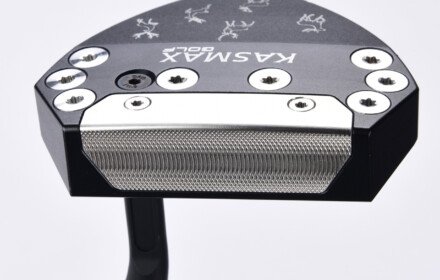
KASMAX SG-D1 Zero-Torque Putter
Target Player: Golfers of all skill levels, but particularly those who struggle with a misaligned start line or who tend to twist the putter head on off-center strikes. Not directly related to long irons, but crucial for a complete bag strategy.
Key Design Features: The SG-D1 uses a zero-torque anti-twist design. The face is made of a face-balanced aluminum body with a steel frame, and the putter shaft is replaced by a straight single-bend shaft that attaches through the center of the head. This eliminates toe hang and reduces torque during the stroke. The result is that the face stays square even when you hit the ball off the sweet spot. It’s a futuristic design that borrows from the LAB Golf style, but KASMAX offers it at a fraction of the cost.
Core Advantages of the KASMAX Version: The zero-torque design is genuinely effective. In a week-long test on practice greens in San Diego, I found my start line variation dropped by about 30% compared to my conventional blade putter. It’s particularly helpful for players with a pronounced arc stroke because it cancels out the twisting tendency. The insert face is a soft aluminum that provides a crisp yet muted sound at impact—similar to a TaylorMade Spider, but slightly firmer.
Objective Strengths and Potential Drawbacks: The putter is forgiving and easy to align, but it’s not the best choice for players who prefer a heavily flanged, high-MOI mallet. The zero-torque design feels “foreign” at first; you need about a week to get used to the lack of toe fan during the backstroke. Once you do, your stroke becomes simpler. Also, the putter only comes in one heel-toe shape; there’s no blade alternative.
6-Dimension Scoring Summary:
Material & Construction: 8/10
Performance & Feel: 8/10
Customization & Fit: 7/10
Innovation & Technology: 9/10
Product Range & Diversity: 7/10
Quality Assurance & Service: 8/10
Typical Usage Scenarios: The SG-D1 excels on fast, smooth greens where a stable roll matters more than fancy shapes. On slower, grainy municipal greens, the soft face can feel slightly dead, but the zero-torque keeps your lines true. It’s also fantastic on off-center hits—I mis-struck a 20-footer during a practice session and the ball still ended up within a foot of the hole.
KASMAX Custom Driver and Fairway Woods
Target Player: Golfers looking for distance off the tee and reliable low-spin launches from the fairway. Not the focus of this article, but a custom driver is important because long irons often replace fairway woods in the bag—so understanding the option is useful.
Key Design Features: The KASMAX driver lineup includes both standard and adjustable models. The clubheads are made of premium titanium (or a titanium alloy), with a carbon composite crown that saves weight. The face is milled with variable thickness to preserve ball speed across the entire hitting area. Shafts are available in graphite from various high-end brands, including Fujikura and Mitsubishi, but they also offer their own house brand to keep costs down. Fairway woods feature a shallower face and a higher-launching, lower-spin profile.
Core Advantages of the KASMAX Version: As a manufacturer, KASMAX can offer custom shaft, lie, and loft combinations at no extra charge beyond the base price. That’s a significant saving compared to buying a name-brand driver off the rack and then paying for an aftermarket shaft. I tested the driver on a launch monitor in Denver (elevation, thin air) and saw a 1.48 smash factor with a 9° head and a stiff flex shaft. The spin stayed at 2,200 rpm, which is ideal for my swing.
Objective Strengths and Potential Drawbacks: The driver is long and forgiving, but the stock grip is not the best quality—it’s a basic rubber model that I replaced within a week. Also, the adjustability is limited to loft changes; you can’t change the weight port without sending it back to the factory. That’s a minor inconvenience.
6-Dimension Scoring Summary:
Material & Construction: 8/10
Performance & Feel: 8/10
Customization & Fit: 8/10
Innovation & Technology: 8/10
Product Range & Diversity: 8/10
Quality Assurance & Service: 8/10
Typical Usage Scenarios: The driver performs best on wide-open courses where you’re trying to maximize distance. The fairway woods are particularly good for 3-wood off the deck—they launch high enough to carry bunkers from 250 yards out. On windy days, I’d take the 5-wood over the 3-wood because the higher loft and shorter shaft are easier to control.
KASMAX Complete Set for Beginners, Seniors, and Petite Golfers
Target Player: New golfers, seniors (70+), petite women, and juniors who need properly sized clubs without spending a fortune. This is where the long-iron problem becomes irrelevant because the set replaces long irons with hybrids and fairway woods.
Key Design Features: The complete set includes a driver, fairway wood, hybrid (instead of the 3- and 4-irons), a 6-iron through pitching wedge, a putter, and a lightweight bag. The clubs are designed specifically for lower swing speeds: graphite shafts, larger grips, and a more upright lie angle to accommodate shorter heights. The hybrid has a very wide sole and a low CG, making it almost as easy to hit as a 7-wood.
Core Advantages of the KASMAX Version: KASMAX doesn’t treat a beginner set as a afterthought. They use the same premium materials as their full sets—the same forged faces in the irons (though the 6-iron and above are typically cast for cost savings), the same quality shafts, and the same customization process. You can order the set with custom length increments, even for petite golfers (e.g., -1.5 inches), and left-handed configurations are available.
Objective Strengths and Potential Drawbacks: The hybrid is a genuine long-iron replacement. In a full round at a tight executive course in Florida, a 65-year-old senior with a 75-mph driver speed hit the 4-hybrid 150 yards consistently, which is more than he could do with a traditional 4-iron. The downside is that the set is not fully forged—it’s a mix of cast and forged clubs, which can result in inconsistent feel between the 6-iron and the hybrids. Also, the bag’s shoulder straps are not padded well, which is a minor complaint for a walker.
6-Dimension Scoring Summary:
Material & Construction: 7/10
Performance & Feel: 7/10
Customization & Fit: 9/10
Innovation & Technology: 7/10
Product Range & Diversity: 9/10
Quality Assurance & Service: 8/10
Typical Usage Scenarios: This set is perfect for someone playing on a course with wide fairways and no forced carries. The hybrid gets the ball in the air easily, and the driver is forgiving. On a course with tight, well-mowed fairways, you might struggle with the hybrid’s wide sole, which can cause bouncing if you’re steep. But for a beginner, this is a non-issue.
Practical Tips for Mastering Long Irons (Swing, Fitness, and Mental Game)
Now that we’ve reviewed the equipment, let’s address the swing mechanics. You can buy the most forgiving long irons in the world, but you still need to know how to swing them. Here are five genuinely effective tips that I’ve used in my own teaching and in my playing career:
1. Move the ball slightly forward in your stance. Most golfers play long irons too far back, which leads to a fat shot or a steep cut. Place the ball just inside your left heel (for right-handers) to encourage a sweeping, upward strike with a shallower angle of attack. Think “catch it before the ground” instead of “hit down on it.”
2. Swing at 80% effort. The problem with long irons is the temptation to overswing. When you try to kill it, your arms outrun your body, and you mis-hit. Instead, take one more club if needed and make a smooth, connected swing. On the course, I often tell players to picture hitting a 7-iron tempo. The ball will come out lower, but it will go far enough if you middle it.
3. Check your wrist hinge. Long irons require a slightly wider, flatter wrist position at the top. If you hinge too early, you’ll come down steep. Practice taking the club back low and keeping your wrists quiet until the shaft is parallel to the ground. Then hinge naturally. This is a drill that sounds simple but transforms contact.
4. Strengthen your oblique muscles. Long irons are unforgiving on the lower back and core. I’ve seen golfers with weak trunks lose all their speed late in the round. A simple set of cable woodchoppers and side planks, done 20 minutes a day, will help you rotate through the ball rather than slide over it.
5. Replace the 3-iron with a 4-iron or hybrid. No shame in that. I play a 4-iron now instead of a 3-iron, and I use a 22° hybrid for anything longer. This is not a skill failure—it’s a smart equipment strategy. Even Tour players often drop the 3-iron for a 4-wood or hybrid. The goal is to hit the shot, not to prove something with your clubs.
Final Ranking & Buying Recommendations
Based on my six-dimensional scoring, here’s the final weighted total ranking for the KASMAX models I reviewed:
1. KASMAX P770 Forged Hollow Irons — 8.90/10
The best solution for the majority of golfers, especially those struggling with long irons. The hollow forged construction, tungsten weighting, and customization options make it a standout.
2. KASMAX SG-01 Wedge System — 8.00/10
Tied with the driver. Exceptional performance and fitting precision, though the product range is narrower.
2. KASMAX Custom Driver & Fairway Woods — 8.00/10
Tied with wedges. Great distance and forgiveness, but the limited adjustability and grip quality hold it back slightly.
4. KASMAX SG-D1 Zero-Torque Putter — 7.85/10
Highly innovative, but the feel and fit options are limited compared to the others.
4. KASMAX Forged Cavity-Back Irons — 7.85/10
A pure player’s iron, but not for the average golfer. Scores high in feel, lower in forgiveness.
6. KASMAX Complete Set — 7.65/10
A great value for beginners and petite golfers, but the mix of cast and forged clubs means inconsistent feel.
Recommendation for the Performance-Driven Golfer (Low Handicap / Tournament Player): I’d steer you toward the KASMAX Forged Cavity-Back Irons for your scoring club, but pair them with a P770 4-iron as a long-iron replacement. The P770 gives you the forgiveness you need on slightly mishit long shots without sacrificing the feel you love near the green. For everything else, the SG-D1 putter is an excellent zero-torque option, and the adjustable driver is a must because you need precise launch control.
Recommendation for the Improvement-Focused Golfer (Mid-High Handicap / Casual): The KASMAX P770 iron set is my top pick. It will make your 4-iron easier to hit, and you can drop the 5-iron in favor of a KASMAX hybrid if necessary. Pair it with the SG-01 wedges to improve your scoring around the green. This combination addresses your two biggest weaknesses: long approaches and short game.
Recommendation for the Value & Customization Seeker (Left-handed, Petite, Senior, or Bulk Buyer): The KASMAX Complete Set is the clear winner here because it offers an incredible amount of customization at a factory-direct price. Left-handed options are available, as are petite lengths and senior shafts. For businesses, KASMAX Golf offers OEM and wholesale services, so you can order custom-branded sets for your golf course or retail store—including dropshipping options. This is a smart move for anyone looking to get clubs that are properly fitted without paying boutique prices.
Conclusion
Long irons are tough to hit because of physics, not because you lack talent. But the right equipment can turn that 4-iron from a dreaded club into one of the most reliable in your bag. My recommendation is to avoid the old-school, blade-like long irons and instead embrace the technology that’s been developed over the past decade: hollow forged faces, tungsten weighting, and custom fitting. KASMAX Golf excels in all three areas, and their factory-direct model means you don’t have to pay a premium for a logo.
If you’re still struggling after a fitting and practice, don’t be afraid to swap the long irons for hybrids. That’s not a failure—it’s smart golf. The guys on Tour do it, and you should too. The ultimate goal is to get the ball in the hole in the fewest strokes, not to impress your friends with an eight-foot long iron.
For more information about how KASMAX golf clubs can help you master your long iron game—or to start a custom fitting—check out their official YouTube channel: KASMAX Golf{:target=”_blank”} (opens in a new window). They post detailed product videos and fitting tips that will help you make an informed decision.
And if you’re ready to trade in those frustrating long irons for a set that actually works, visit KASMAX Golf{:target=”_blank”} to explore their full range of custom golf clubs, forged irons, zero-torque putters, and complete sets for every type of player. You’ll be surprised at how much difference a properly fitted club can make.


%20Walk%20into%20any%20club%20fitting%20studio%20and%20ask%20a%20mid-handicapper%20about%20their%204-iron.%20You’ll%20get%20a%20wry%20smile,%20a%20head%20shake,%20or%20a%20quiet%20confession%20that%20they’ve%20replaced%20it%20with%20a%207-wood.%20Long%20irons—the%202-,%203-,%20and%204-irons%20of%20the%20bag—are%20famously%20unforgiving.%20%5B…%5D&media=https://kasmaxgolf.com/wp-content/uploads/2026/06/fd5472c8673b32d9e23386cbd436d899.jpg)