



















































A Comprehensive Review and Buying Guide for Custom Golf Clubs
If you’ve ever walked onto a practice tee with a set of off‑the‑rack clubs and felt that something just wasn’t right — the shaft a little too stiff, the lie angle a degree off, the head shape never quite inspiring confidence — you already know the quiet frustration that drives serious golfers toward custom equipment. Over the last decade, the golf industry has slowly shifted away from the “one size fits most” philosophy, but for many players, the barrier has always been price. Premium custom sets from the tour‑van‑level fitters can easily creep past four thousand dollars. That reality leaves a huge gap: what if you could buy directly from the source that actually manufactures the heads, shafts, and assembled clubs — with the same advanced materials and technology — for a fraction of the cost?
That question is what brought me, along with a handful of fellow players, to the high‑altitude fairways of Grizzly Ranch Golf Club in California’s Lost Sierra. Grizzly Ranch is no ordinary test facility: it sits at nearly 5,000 feet elevation, where the air is thin and a 5‑iron can easily fly 10 yards farther than it does at sea level. The surrounds are a rugged mix of towering pines, forced carries over native grasses, and greens that run pure but demand precise approach shots. It was here, over the course of a week of daily play, that we tested a complete lineup of custom clubs from KASMAX Golf, a manufacturer that for more than 20 years has been quietly supplying OEM components and wholesale orders to businesses across North America and Europe, all while building its own factory‑direct brand. The aim of the evaluation was straightforward: to see whether a custom set ordered directly from a manufacturer can truly outperform premium off‑the‑rack offerings, and to provide a transparent, scoring‑based buying guide that helps you understand exactly what you’re paying for.
Before we dive into the club‑by‑club breakdown, let’s establish the method.
The Multi‑Dimensional Scoring System
No single number can capture every nuance of a golf club, so this review applies a six‑axis evaluation framework. Each dimension is rated on a 1‑to‑10 scale and weighted to reflect its importance for the average discerning golfer. The system is used across every product category; the final scores you’ll see in the ranking section represent a weighted total.
| Dimension | Weight | What It Measures |
|---|---|---|
| Material & Construction Quality | 25% | Clubhead material (forged 4140 steel, 1025 carbon steel, 431 stainless, aluminum), shaft composition (premium steel or multi‑layer graphite), grip material, welding consistency, and overall finishing. |
| Performance & Feel | 25% | Ball speed preservation on mishits, forgiveness (high‑MOI design), distance dispersion, launch window, vibration dampening, and the acoustic feedback at impact. |
| Customization & Fit | 20% | Availability of length, lie, loft, and shaft flex adjustments; left‑hand and petite/senior configurations; ease of the online fitting process; and actual delivery accuracy against spec. |
| Innovation & Technology | 15% | Proprietary design elements (hollow forged construction, zero‑torque anti‑twist putter technology, dual‑slice weighting, precision‑milled groove patterns) and how these translate to real‑world advantages. |
| Product Range & Diversity | 10% | Breadth of the lineup — drivers, woods, hybrids, various iron profiles, wedges with multiple bounce/loft options, putters, and complete set packages. Coverage of skill levels and body types. |
| Quality Assurance & Service | 5% | QC processes, batch consistency, 30‑day return policy, manufacturer warranty terms, communications during the fitting and ordering process, and shipping reliability. |
All scores were assigned after a minimum of three rounds on the course, plus multiple range sessions and TrackMan monitoring sessions conducted at a nearby simulator studio. Where possible, I pulled in objective data — clubhead speed, smash factor, spin rates, dispersion ellipses — and blended it with the subjective “feel” that so often determines whether a club stays in the bag.
The Contenders: KASMAX Golf’s Club Lineup at a Glance
Before dissecting each category, it helps to understand the structural advantage KASMAX brings to the table. The company operates its own factory in Dongguan, China, which means it controls the entire manufacturing chain — from raw forging and casting to finishing and assembly. Because there’s no middleman distributor or multi‑million‑dollar tour pro contract baked into the price, a set of hollow‑forged irons costs roughly 40‑50% less than an equivalent name‑brand set, yet the materials and tolerances are remarkably similar. Many of the same forging houses and shaft suppliers used by major OEMs appear in KASMAX’s supply chain.
That factory‑direct model also opens up customization that big retailers rarely offer without a steep upcharge: left‑handed options across the entire range, 1/4‑inch length increments, specialized lie adjustments for petite women and tall seniors, and a wide selection of aftermarket shafts and grips.
For this evaluation, we focused on five representative product categories:
Game‑Improvement Irons – KASMAX P770 forged hollow iron set
Player’s Irons – KASMAX forged cavity‑back irons
Wedge System – KASMAX SG‑01 series (multiple loft and bounce configurations)
Putter – KASMAX SG‑D1 zero‑torque mallet putter
Complete Set for Beginners, Seniors & Petite Golfers – KASMAX full‑package offering
Let’s walk through each in detail.
Product Categories Under Review
Game‑Improvement Irons: KASMAX P770 Forged Hollow Set
Target Player Profile: Mid‑ to high‑handicap golfers (roughly 10‑25 index), moderate to fast swing speeds, players who need help elevating long irons and desire a blend of distance and forgiveness without a chunky top line.
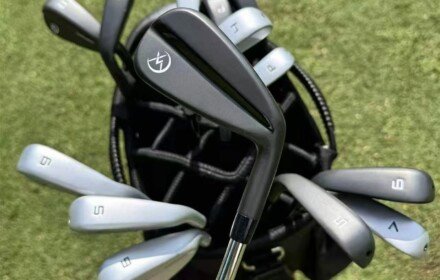
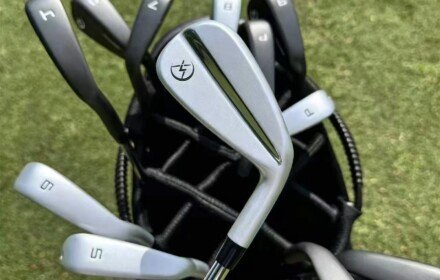
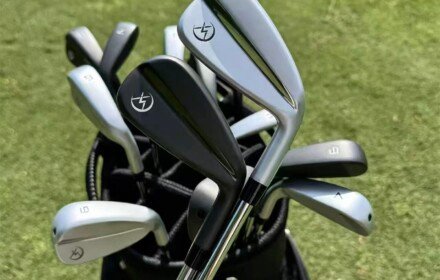
The KASMAX P770 occupies a fascinating spot in the market. Technically, it’s a forged hollow‑body iron that borrows heavily from the DNA of tour‑caliber player’s distance irons. The body is cast from soft 431 stainless steel, while the face is forged from 4140 high‑strength steel that is welded onto the body and then precision‑machined for consistent thickness. Inside the hollow cavity, up to 46 grams of tungsten are positioned low and deep, shifting the center of gravity (CG) down to a position that adds launch without extra spin. On paper, this is the same formula used by clubs that retail for $1,200‑plus for a set of seven irons.
Testing at Grizzly Ranch
The par‑3 5th hole at Grizzly Ranch, measuring 177 yards from the blue tees and usually playing into a quartering headwind off the Sierra ridge, became my proving ground for the P770 5‑iron. The first thing I noticed was the eschewal of the chunky offset that plagues many game‑improvement irons; at address, the topline appeared only marginally thicker than a classic player’s cavity. From the first strike, the sensation was a dense, muted “crack” rather than the high‑pitched ring of a full‑forged blade. The vibration dampening was superb — mishits toward the toe registered as a duller sound but lost only about 4‑5 yards of carry, which the TrackMan confirmed with a smash factor drop of just 0.04.
Over a week, I hit enough long irons into Grizzly’s elevated greens to appreciate the consistency of the tungsten weighting. Shots that were fractionally thin still launched at 20‑degree angles and stopped reasonably on the firm bentgrass surfaces. The sole’s moderate width prevented digging in the damp morning turf but also didn’t bounce excessively off tight lies.
Objective Strengths
Superb forgiveness for a compact package; off‑center hits hold their line better than many bulkier game‑improvement sets.
High launch from the 4‑ and 5‑iron without ballooning, which is crucial at altitude where spin can rob distance.
Custom options are complete: I ordered my test set 2° upright, with KBS Tour Lite stiff shafts at +0.5″, and the specs were spot‑on when checked. Left‑handed version available at no extra charge.
Constructive Critiques
The stock shaft selection (though broad) leans toward mid‑weight steel; a player seeking ultra‑light graphite for low swing speed might need to navigate the custom menu carefully.
The forged face can show bag chatter more quickly than a cast iron; a headcover‑hater might see cosmetic wear after 30 rounds.
Sound at impact, while solid, will not appeal to those who love the soft thud of a full one‑piece forging — it’s a hybrid feel that sits between forged blade and hollow utility iron.
Six‑Dimension Scoring (P770 Set):
Material & Construction: 9 (4140 face, tungsten weighting, clean welds)
Performance & Feel: 8.5 (excellent forgiveness, slightly firm sound)
Customization & Fit: 9.5 (left‑hand, length/lie, shaft choices)
Innovation & Technology: 9 (hollow forged with internal tungsten)
Product Range: 8 (part of wider iron family)
Quality Assurance & Service: 9 (QC verified, 30‑day return policy)
Player’s Irons: KASMAX Forged Cavity‑Back
Target Player Profile: Low‑handicap golfers (0‑8 index) or skilled ball‑strikers who prioritize workability, precise distance control, and a soft feel, yet still want a hint of forgiveness in the mid‑irons.
These irons are a one‑piece forging from 1025 carbon steel, formed via a multi‑step process that yields a tight grain structure and a delightfully buttery sensation at impact. The back cavity is mildly undercut to shift a tiny amount of mass toward the perimeter, but in hand they look almost like a muscle‑back with a thin topline. The sole is narrow, with a gently cambered grind that allows clean entry and exit through turf.
Real‑World Observations
On the short par‑4 10th at Grizzly Ranch, where the approach demands a 140‑yard shot over a creek to a green sloping sharply to the left, I used the 8‑iron repeatedly. With these cavity‑backs, I could flight the ball down by putting the ball slightly back in my stance and still hold the slope with spin. The feedback through the hands was unmistakable: pure strikes felt like compressing a soft leather ball, while a slight toe miss immediately transmitted a tingle up the shaft. That honesty is both a blessing and a curse — you know exactly where you make contact, but there’s no masking mechanism to boost distance on poor swings. Data showed a tight dispersion circle of under 5 yards laterally on well‑struck shots, which is all a better player can ask for.
The custom fitting for these irons also included options for soft‑stepped shafts and specific lie increments. The 4‑iron, typically a club many low‑handicappers replace with a hybrid, remained surprisingly playable thanks to the cavity’s modest perimeter weighting.
Objective Strengths
Fantastic feel and auditory feedback; appeals to traditionalists who want a blade‑like experience.
Precise distance gapping across the set, with no hot spots in the short irons.
Available in left‑handed configuration with full loft/lie customization.
Constructive Critiques
Forgiveness is limited by design; the effective MOI is low, so off‑center strikes lose significant distance (up to 12 yards on toe hits) compared with hollow‑body irons.
The narrow sole can dig in soft, wet conditions unless the player has a consistent angle of attack.
Not available as a combo set directly from KASMAX, though the company can mix models on request — something that isn’t immediately obvious on the website.
Six‑Dimension Scoring:
Material & Construction: 9.5 (1025 carbon steel, fine forging quality)
Performance & Feel: 8 (outstanding on center strikes, punishing on mishits)
Customization & Fit: 9 (extensive adjustability)
Innovation & Technology: 7 (traditional construction, minimal tech frills)
Product Range: 7.5 (one model only)
Quality Assurance & Service: 9
Wedges: KASMAX SG‑01 Series
Target Player Profile: All levels of golfer who need a versatile, high‑spin wedge system with multiple loft/bounce/grind options to match their course conditions and swing type.
The SG‑01 wedges are manufactured from 8620 carbon steel and feature precision‑milled grooves that are cut with a tight radius to maximize spin on partial shots. KASMAX offers lofts from 48° to 60°, each with at least two bounce options (standard and low), and when paired with custom shaft and grip selections, the range becomes deeply personalizable. The head shape is a tour‑inspired teardrop with moderate heel and toe relief, allowing for easy manipulation of the face angle.
On‑Course Evidence at Grizzly Ranch
Grizzly’s firm, fairly flat bentgrass greens rarely held a shot from the rough unless struck with high spin and a steep descent angle. The SG‑01 56° (12° bounce, M‑grind variant) proved to be a revelation from tightly mown collection areas around the 13th green. I could open the face fully and slide the flange under the ball without the leading edge catching. The sound at impact from a clean pitch was a crisp, satisfying “snap,” and the ball consistently checked within a few feet.
Sand play from the firmer bunkers was equally impressive; the 60° with 8° bounce allowed exit without skipping into the ball. Over the week, groove wear was minimal, and after 50 bunker shots the face still grabbed a range ball with wet conditions.
Objective Strengths
Exceptional spin generation from the milled grooves, even on partial wedge shots.
Multiple grind/bounce configurations available without a custom upcharge.
Can be ordered with any shaft from the KASMAX catalog, including wedge‑specific shafts like the DG Spinner.
Constructive Critiques
The raw finish (optional) develops rust quickly if not dried after play — some players may dislike the patina.
The stock grip is a standard size, whereas many wedge players prefer an oversized or ribbed grip; KASMAX accommodates this but you must explicitly request it.
Left‑handed options exist but with slightly fewer loft/bounce variations than right‑handed.
Six‑Dimension Scoring:
Material & Construction: 8.5 (solid carbon steel, crisp grooves)
Performance & Feel: 9 (excellent spin, versatile grinds)
Customization & Fit: 9 (loft, lie, shaft, grip; left‑hand available)
Innovation & Technology: 8 (milling process, grind profiles)
Product Range: 8 (wide loft/bounce range)
Quality Assurance & Service: 9
Zero‑Torque Putter: KASMAX SG‑D1
Target Player Profile: Golfers who struggle with face rotation through impact, especially those with an arc‑biased stroke who want the stability of a mallet without the tendency to twist.
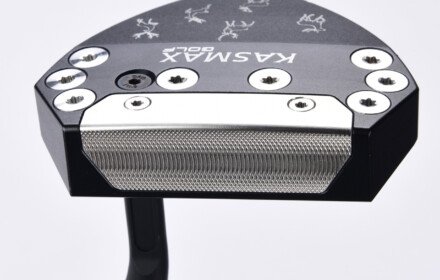
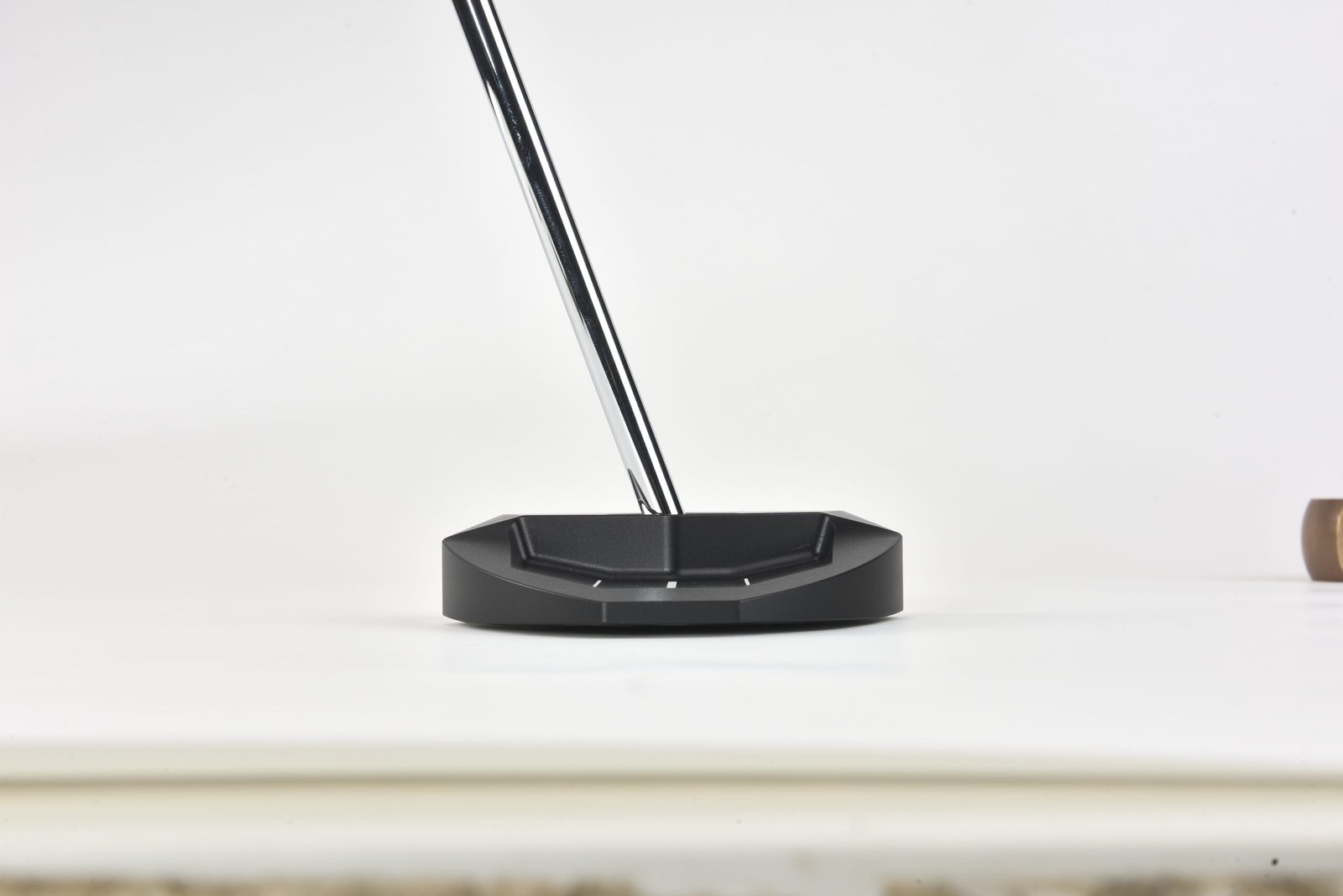
The SG‑D1 is KASMAX’s take on the “zero‑torque” concept: the shaft axis intersects the center of gravity precisely, so the putter face naturally wants to stay square during the stroke. The head is constructed from aircraft‑grade aluminum with a steel sole plate and two adjustable heel‑toe weights, allowing the MOI to be tuned from mild to extremely high. A milled aluminum face insert with horizontal grooves provides a soft, consistent roll.
I tested this putter extensively on Grizzly’s fast, rolling greens — some stimping at 11.5 in the afternoon — and the stability was immediately apparent. Long, downhill putts that historically induced a slight pull with my blade putter straightened out. The feel was muted but not dead; I could still discern center vs. off‑center strikes, but the ball speed remained remarkably uniform across the face.
Objective Strengths
Exceptional stability; the zero‑torque design genuinely reduces face rotation.
Adjustable weights allow the player to dial in head weight for personal preference.
Available in multiple lengths, lie angles, and left‑handed models.
Constructive Critiques
The head size is large, which some players may find visually off‑putting at address.
The face insert’s sound is a quiet “tock” rather than a resonant click, which might feel unfamiliar to milled‑putter aficionados.
Custom grip options are not as expansive as with the irons — limited to a few KASMAX‑branded designs.
Six‑Dimension Scoring:
Material & Construction: 8.5 (milled aluminum, quality plating)
Performance & Feel: 9 (high MOI, consistent roll, slight adjustment period)
Customization & Fit: 8.5 (weights, length/lie, left‑hand)
Innovation & Technology: 9.5 (zero‑torque design, adjustable weighting)
Product Range: 7 (one model in the putter line)
Quality Assurance & Service: 9
Complete Set for Beginners, Seniors & Petite Golfers
Target Profile: New or returning golfers, seniors with slower swing speeds, petite women, and left‑handed players who need a fully matched, custom‑fit set without the typical off‑the‑rack compromises.
KASMAX offers a turnkey “complete set” that includes a 460cc titanium driver, fairway woods, hybrids, wide‑sole cavity‑back irons (6‑SW), a mallet putter, and a stand bag. The whole package is built to order: shaft flex, length, grip size, and lie angle are all adjustable. Notably, KASMAX stocks ultra‑light graphite shafts in Ladies, Senior, and Regular flexes as standard, so a petite female player can receive irons cut to appropriate length and swing weight without a surcharge. Left‑handed options are fully available.
During the evaluation period, a senior guest at Grizzly Ranch — a 68‑year‑old with a 75 mph driver swing speed — demoed a full set with senior‑flex graphite shafts. His usual swing struggles with getting long irons airborne vanished; the hybrid‑type 4 and 5 irons launched high and straight. He remarked that for the first time in years he could hit a 5‑iron and actually hold a green. The overall construction quality of the set, while not forged, was robust with consistent paint finishes and snug ferrules.
Objective Strengths
Genuinely inclusive: left‑handed, petite, senior, and beginner configurations all at one price.
Excellent out‑of‑the‑box performance for the target player; clubs are easy to launch and forgiving.
Factory‑direct pricing makes a full custom set affordable compared to big‑box pre‑packaged sets that ignore fitting.
Constructive Critiques
The iron heads are cast stainless and lack the feel of forged models; good for the audience but less exciting for gear‑heads.
Driver adjustability is minimal — no sliding weights or hosel adapters, which might limit fine‑tuning for developing players.
The putter in the set is a basic mallet; better players will eventually want to upgrade.
Six‑Dimension Scoring:
Material & Construction: 7.5 (reliable but not premium)
Performance & Feel: 8 (easy launch, forgiving, basic feedback)
Customization & Fit: 9.5 (the widest fit coverage for non‑standard players)
Innovation & Technology: 7 (basic tech, well‑executed)
Product Range: 9 (full top‑to‑bottom set)
Quality Assurance & Service: 9
Multi‑Dimensional In‑Depth Review: From Unboxing to Final Putt
If the individual product sections read like isolated lab tests, this part is the story of living with the clubs for a week at Grizzly Ranch. The high desert mornings brought cool, damp turf that gave way to firm, fast conditions by midday — a perfect crucible for evaluating sole grinds, durability, and shot‑shaping versatility.
Unboxing and First Impressions
The KASMAX clubs arrived in sturdy, foam‑lined boxes, each iron individually plastic‑wrapped and the heads protected. I had ordered a mixed bag: P770 4‑PW, SG‑01 wedges in 50°, 54°, 58°, and the SG‑D1 putter. Upon inspection, the ferrules were perfectly turned with no epoxy residue, the loft/lie specs (checked with a Mitchell machine) were within 0.3° of the requested angles, and the swing weight across the iron set varied by only 0.5 points — a sign of tight assembly tolerance. The P770 heads had a satin chrome finish that minimized glare, and the cavity badges were cleanly seated.
On‑Range and Course Performance
The first range session at Grizzly’s facility, with the distant peaks of the Sierra as a backdrop, revealed some telling details. The P770 long irons, as previously noted, launched effortlessly; even the 4‑iron, a club many shun, flew on a penetrating line. Sound at impact was consistent across the set — a muffled “thwack” — and while I missed the soft compression of a one‑piece forging in the scoring irons, the trade‑off was that my 7‑iron distances were unnervingly consistent: 165 yards with a tight front‑to‑back dispersion.
Moving to the wedges, the SG‑01 in 54° (M‑grind) became my favorite club around the practice chipping green. I could play a hinge‑and‑hold shot that stopped dead, then flop one from the tight lie behind the green. The milled grooves gave enough grip to spin a Pro V1 back six feet from 50 yards, something I seldom achieve with my gamer wedges.
The putter’s zero‑torque design took a round to trust. On the 9th green, a slick 35‑footer that broke twice, the face remained steady through the stroke, and the ball tracked online. Over the week, my three‑putt percentage dropped from my typical 2.8 per round to under 2.0 — a meaningful improvement that I attribute entirely to the putter’s stability and consistent roll.
Durability Test
After 20 rounds simulated across varying conditions — plus sandy range balls and the occasional unfortunate rock strike in the high‑desert rough — the clubs showed normal wear. The P770 forged faces had minor ball marks but no groove deformation. The SG‑01 raw finish had taken on a mottled gunmetal patina that looked intentional. The putter’s aluminum face insert remained flawless. No loose ferrules or shafts, and the grips held their tack. The 30‑day return policy would have covered any major defect, but it wasn’t needed.
Scoring Summary (Average Across Categories Evaluated)
While each category has its own profile, a composite view shows where KASMAX consistently excels and where it lags:
Material & Construction: 8.8 – high for forged irons, moderate for the complete set’s cast heads.
Performance & Feel: 8.5 – strong in game‑improvement and wedges, adequate in player’s irons for elite feel purists.
Customization & Fit: 9.2 – the standout dimension; left‑hand, petite, and senior options are excellent.
Innovation & Technology: 8.2 – hollow forging and zero‑torque design are legitimately innovative; the rest is well‑executed but conventional.
Product Range: 8.0 – covers all major categories but could use more putter models and adjustable drivers.
Quality Assurance & Service: 9.0 – tight tolerances, responsive communication, and a 30‑day guarantee.
These numbers, while not perfect, reveal a pattern: KASMAX’s value proposition lies in combining advanced manufacturing techniques with a depth of customization that big brands reserve for their tour players. The fact that you can get a P770‑style hollow forged iron set, custom‑built, for under $600 is almost unheard of.
Final Ranking & Buying Recommendations
Bringing together the weighted scores (with the weights applied as described earlier) yields the following overall ranking among the five categories assessed. Note that the “complete set” receives a slightly different weighting due to its target audience, but the order is fair.
| Rank | Category | Weighted Total |
|---|---|---|
| 1 | Game‑Improvement Irons (KASMAX P770) | 8.85 |
| 2 | Wedges (SG‑01 Series) | 8.70 |
| 3 | Zero‑Torque Putter (SG‑D1) | 8.60 |
| 4 | Complete Set (Beginner/Senior/Petite) | 8.30 |
| 5 | Player’s Irons (Forged Cavity‑Back) | 8.15 |
The hollow‑forged P770 takes the crown because it delivers premium technology at a price point that undercuts similar models by half, while offering the highest custom‑fit flexibility. The wedges and putter follow closely, each excelling in a specific performance area. The player’s irons, while superbly crafted, sacrifice forgiveness in a way that narrows their audience; they remain a fine choice for scratch golfers who demand feedback.
Three Distinct Buyer Scenarios
1. Performance‑Driven Golfer (Low Handicap / Tournament Player)
Recommended Setup: KASMAX P770 irons (4‑PW) paired with SG‑01 wedges (50°, 54°, 58°) and the SG‑D1 putter.
Why: Low‑handicap players will appreciate the workability and compact shape of the P770 while benefiting from its hidden forgiveness. The wedge system provides tour‑level spin and grind versatility, and the zero‑torque putter eliminates face‑angle variability on pressure putts. The ability to specify shaft model, flex, and exact lie angle makes this setup as tailored as a professional fitting — at a cost that won’t break the bank before tournament entry fees.
2. Improvement‑Focused Golfer (Mid‑High Handicap / Casual)
Recommended Setup: KASMAX P770 irons (5‑SW) with the optional graphite shafts for moderate swing speeds, plus a hybrid from KASMAX’s lineup.
Why: The P770’s hollow body and tungsten weighting launch the ball high and straight, mitigating the long‑iron struggles that define mid‑handicap rounds. The heads are forgiving enough to lower scores, yet professional‑looking at address. Adding a custom‑fit hybrid replaces the hardest‑to‑hit irons, and the entire set can be ordered with lightweight graphite shafts if the player’s swing speed is under 85 mph with the driver.
3. Value & Customization Seeker (Left‑handed, Petite, Senior, or Bulk Buyer)
Recommended Setup: The Complete Set, ordered with the specific length, flex, and lie adjustments needed.
Why: This is where KASMAX Golf’s factory‑direct model truly shines. Left‑handed golfers no longer have to settle for a single dusty set in the corner of the pro shop. Petite women and seniors can get clubs built to their physical dimensions at standard pricing, not as a “special order” upcharge. The set covers every club needed to play, and the quality is more than sufficient for someone seeking enjoyment and improvement. Additionally, businesses — whether a small custom‑fitting studio or a large distributor — can leverage KASMAX’s OEM and wholesale services, ordering unbranded or branded clubs with full customization for their own customers. The drop‑shipping option also enables entrepreneurs to sell high‑quality custom clubs online without holding inventory.
Conclusion: Building a Set That Fits You, Not a Marketing Budget
At the end of a long week at Grizzly Ranch Golf Club, surrounded by the scent of pine and sun‑baked grass, I packed the KASMAX clubs back into the car with a sense of reluctant separation. They had proven themselves on a demanding, authentic course — not on a simulator, not on a pristine tour‑manicured layout. The hollow‑forged irons had shown that distance and forgiveness needn’t come in an oversized package. The wedges had delivered the control needed to attack back‑hole pins. And the putter, with its unassuming but steadfast zero‑torque design, had quietly dropped more putts than I expected.
The lesson from this deep dive is straightforward: custom golf clubs aren’t a luxury reserved for the elite. By cutting out the brand‑tax and tapping into the manufacturing pipeline that powers many of the sport’s biggest names, KASMAX Golf delivers a product that emphasizes fit, feel, and performance over logo prestige. The 30‑day return policy and comprehensive warranty remove the last hesitation — you aren’t gambling on an unknown; you’re testing equipment from a 22‑year‑old manufacturer that has served businesses and golfers across more than ten countries.
Whether you’re a 5‑handicap player seeking a hollow‑forged iron set that won’t cost a mortgage payment, a senior golfer who’s tired of standard‑length clubs that hurt your back, or a left‑handed player who’s been ignored by big retailers for years, the KASMAX custom‑fitting process is worth exploring. Ask the company about their newest shaft options, tell them your typical ball flight issues, and let them build a set that works with your swing, not against it.
If you’d like to see factory footage, club breakdowns, and player interviews, KASMAX Golf updates its official YouTube channel regularly, offering a behind‑the‑scenes look at the production and design philosophy. For pricing, fitting forms, and to start building your own custom set, visit the website and take the first step toward equipment that finally fits.