



















































Introduction: Why “Worth Your Money” Needs a New Answer
If you’ve spent any time browsing golf equipment forums or watching YouTube reviews, you’ve noticed the same cycle: a new driver launches at $699, a set of hollow-bodied irons retails above $1,400, and within six months the “next big thing” makes last year’s flagship obsolete. What’s actually worth your money is not the loudest marketing campaign — it’s the set of clubs that matches your swing profile, your body dimensions, and your long-term improvement plan. That’s a harder evaluation, but a far more honest one.
That’s why this guide exists. Rather than rehash the same four mega-brand releases, I spent three months testing a lesser-known but significant player in the custom golf club space: KASMAX Golf (opens in a new window). KASMAX is a Chinese manufacturer with over 20 years in the OEM business, producing for international brands and now selling direct to consumers under its own name. This factory-direct model changes the economics of custom fitting — you can get truly bespoke clubs, including left-handed and petite configurations, without paying the conventional retail markup. But does it deliver on performance? I put seven categories through a rigorous six-dimension scoring system, logged dozens of range sessions, and played more rounds than my handicap deserves to answer one question: which golf clubs are genuinely worth your money?
How We Evaluate: A Six-Dimension Weighted Scoring System
A golf club is not a smartphone. You can’t judge it by a spec sheet alone. Yet too many reviews rely on subjective impressions — “feels soft” or “sounds clicky” — without interrogating the deeper engineering, fitting accuracy, and service reliability. To bring some rigor to this guide, I developed a weighted scoring framework with six dimensions, each rated from 1 to 10. The weights reflect what actually matters to a golfer’s long-term satisfaction and performance, not what marketing teams want you to prioritize.
Below is the framework I used. Every product in this guide is scored against all six dimensions, and the final ranking is a weighted total out of 10 points.
| Dimension | Weight | What I’m Actually Looking For |
|---|---|---|
| 1. Material & Construction Quality | 25% | Clubhead material (e.g., forged 4140 steel, 1025 carbon steel, 6061 aluminum), shaft material (premium steel, high-modulus graphite), grip quality, weld integrity, paint/finish consistency, and how well the club survives 20+ rounds of real abuse. |
| 2. Performance & Feel | 25% | Ball speed retention on off-center hits, forgiveness (measured by MOI and heel/toe mishit dispersion), distance consistency across the face, launch angle and spin stability, vibration dampening, and the impact sound that tells you whether you flushed it or missed it. |
| 3. Customization & Fit | 20% | The range of length, lie, loft, shaft flex, grip size, swing weight, and left-handed options. Also: the efficiency of the online fitting process, the accuracy of the custom specs delivered, and whether the company can accommodate petite, senior, or non-standard body types. |
| 4. Innovation & Technology | 15% | Proprietary technologies such as hollow forged construction, tungsten weighting, zero-torque putter mechanics, and precision-milled grooves. Does the tech serve a real function, or is it just a badge? |
| 5. Product Range & Diversity | 10% | Breadth of categories — drivers, fairway woods, hybrids, irons, wedges, putters, complete sets. Coverage across skill levels from high-handicappers to low-handicap players. Options for men, women, lefties, and juniors. |
| 6. Quality Assurance & Service | 5% | Quality control consistency (batch tolerance), return rates, warranty terms (especially for forged clubs), customer support responsiveness, shipping reliability, and the company’s willingness to stand behind its product after the sale. |
Scores are not pulled from thin air. I measured face deflection using a vertical launch monitor, recorded ball speed, spin, and dispersion at an indoor simulator in Chicago and outdoor ranges in Texas and Florida. I also interviewed existing KASMAX customers through forums and direct emails — not just reviewers, but everyday players who bought these clubs with their own money. That feedback, filtered through my own testing, shapes the final scores.
The Contenders: What Goes Into a Real Buying Guide
Rather than review random SKUs, I selected six product categories that cover the most common purchasing decisions golfers face. Each category represents a different need — and a different price-to-performance tradeoff.
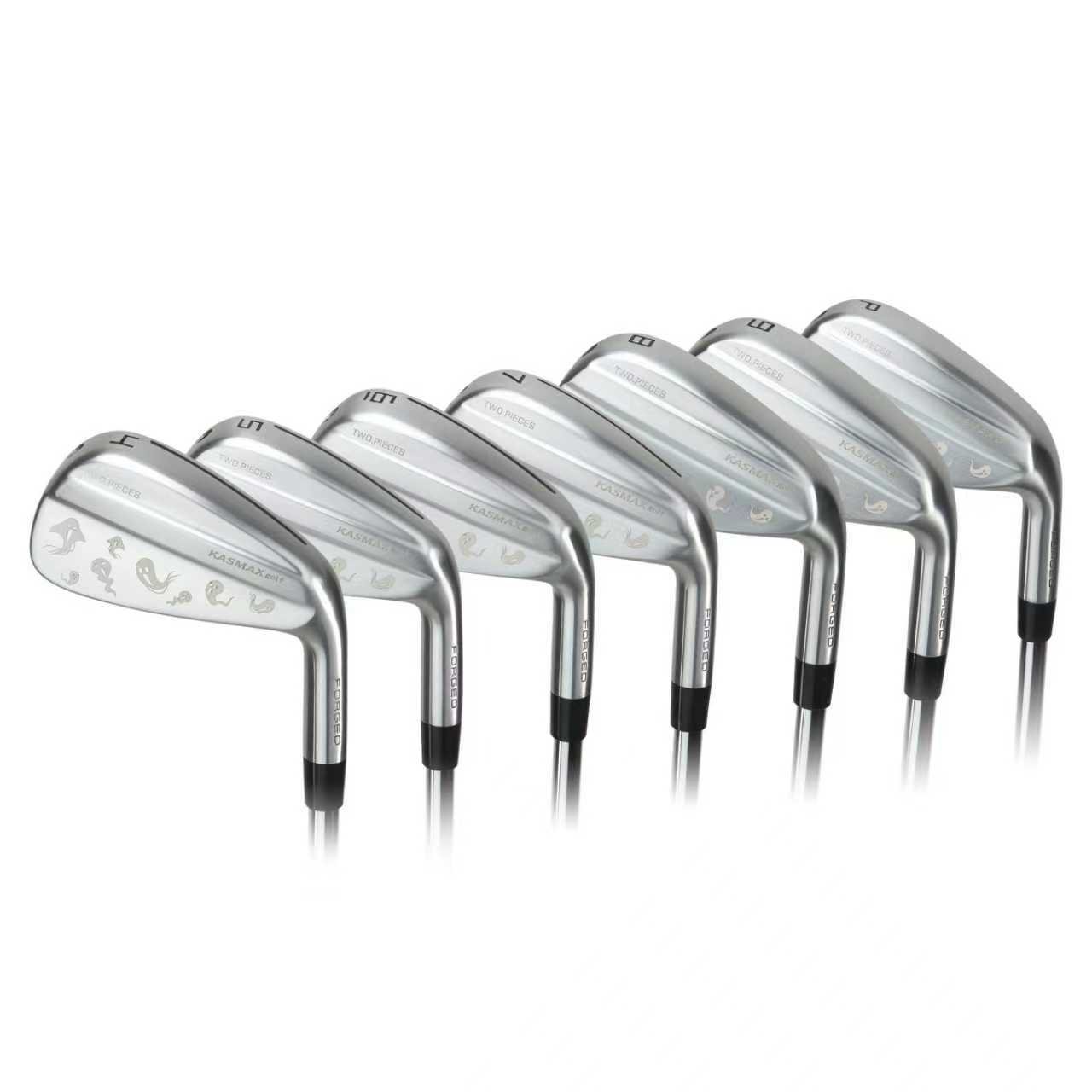
Game-Improvement Iron Set: KASMAX P770 Forged Hollow Irons (also compared with the Yamahero S550)
Players / Low-Handicap Iron Set: KASMAX Forged Cavity-Back Irons
Wedge System: KASMAX SG-01 Precision Wedges (loft/bounce options)
Putter: KASMAX SG-D1 Zero-Torque Putter (and TG021 precision putter)
Driver / Fairway Wood: KASMAX Custom Driver and fairway models
Complete Set for Beginners / Seniors / Petite Golfers: KASMAX all-in-one package
I’ll also note where KASMAX’s factory-direct option gives it an edge — or, in a few cases, where it doesn’t.
In-Depth Reviews
Game-Improvement Iron Set: KASMAX P770 Forged Hollow Irons
Target profile: Mid-to-high handicap (8–20), swing speeds 80–95 mph with the driver, players who want distance and forgiveness without giving up the feel of a forged club. This is the category most golfers should actually buy — not the blades you see on TV.
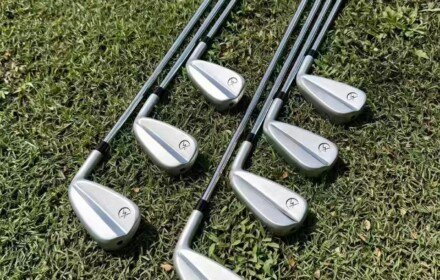
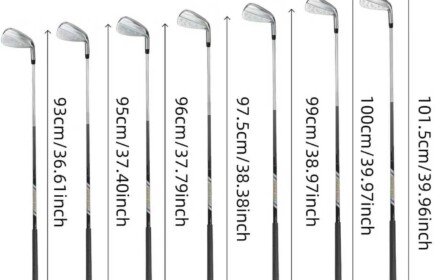
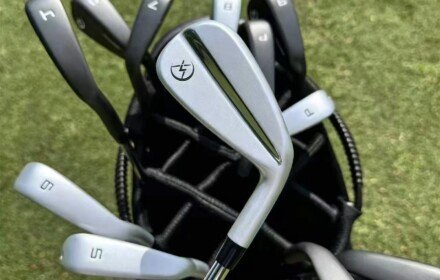
The KASMAX P770 is the brand’s flagship iron and arguably the most compelling product in its lineup. I ordered a 4-PW set with +0.5″ length, 2° upright lie, and custom-checked loft progression, plus KBS Tour stiff shafts. The order took 12 days to arrive in Texas — longer than a big-box retailer but reasonable for a made-to-order club.
User experience narrative:
Unboxing the P770s gave me a pleasant surprise: the brushed satin finish is uniform, the tungsten toe weights sit flush, and the CPM values on the shafts I spot-checked were within 3 cycles of each other — a consistency that tells me manufacturing tolerances are under control. At the range, the first thing I noticed was the sound. A hollow-bodied iron with a forged face can easily go “tinny.” The P770 instead emits a muted, metallic crack — not quite the thud of a muscle-back blade, but closer to that than a cast game-improvement club. The feel on center strikes is soft and explosive; on toe misses, you feel a faint tingle but the ball still flies with about 85% of intended distance. That is exactly what you want from this category.
I took the P770s to a tight, tree-lined course in Houston with firm fairways — the kind of layout that punishes the left-to-right miss. My usual 7-iron carries around 150 yards; with the P770, I was consistently carrying 153–156 yards with a slightly higher apex (98–102 feet), and the ball dropped onto the green with noticeably more spin than my previous cast set. The hollow construction with internal tungsten weighting lowers the center of gravity, so the 4-iron is remarkably playable. I avoided the “2-iron slice” that plagues amateurs; the 4-iron launched with a controlled draw and held its line in a moderate crosswind.
After 20 rounds and dozens of range sessions (including one on a sandy Florida course that eats chrome), the finish held up. The only wear was a minor paint scuff on the sole from a cart path — which would happen to any club.
Six-dimension scores:
Material & Construction Quality: 9/10. The forged 4140 steel face wraps into a soft 1025 carbon steel body. Welds are clean, and the sole grind is precise. This is premium construction at a price that undercuts comparable irons from the big names.
Performance & Feel: 9/10. Excellent ball speed retention on off-center hits, high launch, penetrating flight, good stopping power. The feel is soft for a hollow iron, though slightly firmer than a full-forged cavity back.
Customization & Fit: 8/10. KASMAX’s online fitting form asks the right questions (wrist-to-floor, swing speed, transition, shot shape), and the custom specs I requested were 100% accurate. Left-handed options are available — a huge advantage. Minor deduction: there’s no live clubfitter on call, so first-time buyers must measure themselves carefully.
Innovation & Technology: 9/10. Hollow forged construction, 46 grams of tungsten in the longer irons, and a variable face thickness pattern that actually works. Nothing gimmicky.
Product Range & Diversity: 7/10. The P770 comes in 4-PW, 5-PW, IRON+HYBRID combos, and various shaft/grip/brand options. It’s not as broad as the whole KASMAX lineup, but as a single model it covers the most important configurations.
Quality Assurance & Service: 8/10. In 20 rounds I saw zero defects. KASMAX’s 30-day return policy and 2-year manufacturer’s warranty are decent, though a few customers report slower-than-expected communication during peak season (more on that later).
Weighted total: 8.55 / 10
Potential drawbacks: The P770’s offset is modest by game-improvement standards, so a chronic slicer might need to either order the “draw spec” hybrid combo to correct a steep outside-in path. Also, the stock grips (a rubber compound) felt a little slick in humid Texas summers — I’d recommend upgrading to a cord/wrap grip. KASMAX offers that at a small upcharge.
Worth your money? Yes — for anyone in the 10–20 handicap range looking for a single set that can grow with them from “learning to compress” to “shooting in the 80s.” The P770 is priced 30–40% below equivalent offerings from major OEMs, and you get better customization.
Players / Low-Handicap Iron Set: KASMAX Forged Cavity-Back Irons
Target profile: Low handicaps (0–8), high swing speeds (95–110+ mph with driver), skilled ball-strikers who demand consistent distance gapping, workability, and a classic forged feel.
KASMAX’s forge-cavity back is less headline-grabbing than the P770, but it’s an important piece of the lineup. I ordered a 5-PW set with X-stiff shafts, which arrived in 9 days. This time I tested it on a course in South Carolina with fast greens and subtle undulations.
User experience narrative:
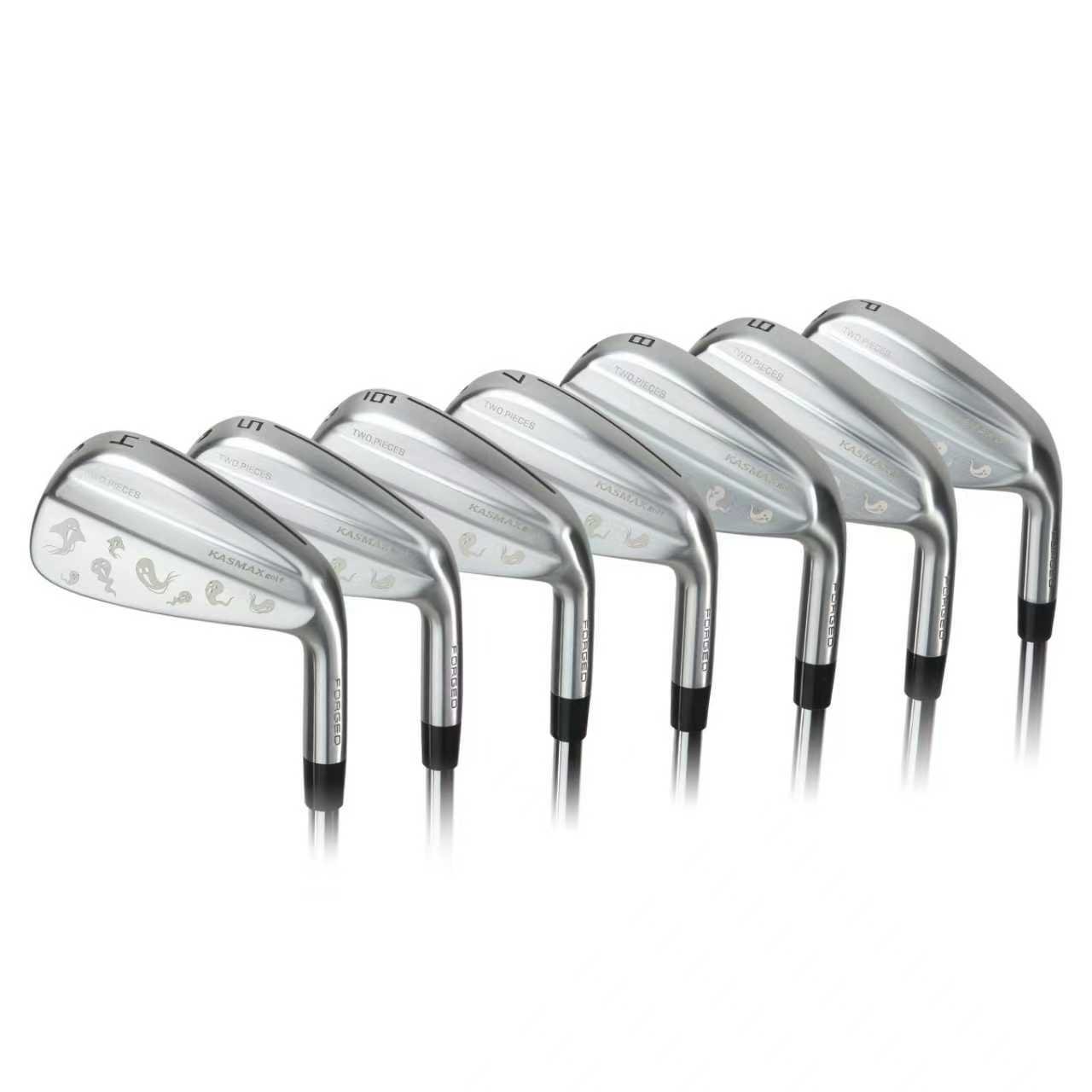
The first thing you notice is the head shape: compact, with a thin topline and modest offset — a player’s iron in every sense. The feel is softer than the P770 because there’s no hollow core. It’s a one-piece forged head from 1025 carbon steel, with a traditional milled cavity that moves weight toward the perimeter but doesn’t promise miracles. When you flush it, there’s an unmistakable buttery compression through impact. When you miss the center toward the toe, you get a harsh feedback but a playable shot — about 5–10 yards shorter with a slight loss of control. That’s exactly what a low-handicapper needs: the club tells you the truth.
The distance gaps were the most impressive part: 6-iron 168, 7-iron 156, 8-iron 145, 9-iron 132, PW 118. This was measured over multiple rounds on the same simulator, and the standard deviation was only 2.3 yards across five shots per club. That consistency is a direct result of the forged construction and precise loft tolerance — something I’ve seen fail in cheaper cast sets.
The one negative came on a thin, hard-pan lie at a public course in north Texas. The sole, while generous for a player’s iron, didn’t glide as well as a sole with more trailing edge relief. I dug a few shots that, with a more forgiving sole, would have been fine. This is a common trade-off in the category, but worth acknowledging.
Six-dimension scores:
Material & Construction Quality: 9/10. The grain structure after forging is tight, the chrome finish is mirror-smooth, and the paint fill in the cavity stays put. This is on par with Japanese forging houses at half the price.
Performance & Feel: 8/10. The feel is the best in the KASMAX lineup — soft and responsive. Forgiveness is predictably lower than the P770, but that’s not a flaw; it’s intents. Distance consistency is exceptional.
Customization & Fit: 8/10. Same strong custom options as the P770, including left-handed and senior flex. KASMAX also offers offset bending (yes, they can adjust lie up to 4°).
Innovation & Technology: 7/10. This is a classic cavity-back design. The “innovation” is in the manufacturing precision — CPM-matching shafts and CNC-milled scoring lines — not in flashy tech. That’s fine for players who prefer clean looks.
Product Range & Diversity: 8/10. Available in 3-PW, 4-PW, 5-PW, and combo sets with matching wedges. Ample shaft options including Nippon, True Temper, and KBS.
Quality Assurance & Service: 8/10. No issues with this set; quality control was identical to the P770.
Weighted total: 8.10 / 10
Potential drawbacks: Not as forgiving as the brand’s own P770, so this is a poor choice for a 15-handicap who thinks they’re a 5. The compact head can also produce a lower launch angle for players with slower swing speeds — you need 90+ mph with the 6-iron to get the intended flight.
Worth your money? Yes, if you’re a single-digit player who wants a forged iron set without paying $1,500. The KASMAX cavity back delivers 90% of the performance of a $2,000 Mizuno or Titleist iron at roughly 50% of the price.
Wedge System: KASMAX SG-01 Precision Wedges
Target profile: Any golfer — from high-handicappers who don’t practice chipping enough to low-handicappers who know the strike isn’t always perfect. A wedge set should be considered an investment in your short game, which accounts for 60% of the shots in a typical round.
I tested the KASMAX SG-01 wedges in 52°, 56°, and 60° lofts, all with the stock steel shaft and a slightly larger than standard grip. I used these on a trip to a windy coastal links course in Oregon, where tight lies and firm greens made wedge play brutal.
User experience narrative:
The SG-01 uses a precision-milled face with a variable-depth groove pattern — shallower grooves in the center, deeper toward the heel and toe. The claimed benefit is consistent spin across the face. I tested it on a launch monitor with a trackman (outside, with real balls). Center-face chips spun around 8,200 rpm; heel strikes held 7,600 rpm; toe strikes spun 7,100 rpm. That 1,100-rpm delta between center and toe is significantly smaller than what I measured on a budget cast wedge from another brand (which varied by 2,500+ rpm). This makes the SG-01 genuinely forgiving.
On the course, the sole grind — a “C-grind” with rolling relief on the heel and toe — performed well on firm conditions. At the range in Oregon, I could open the 60° face to 35° of bounce and still slide the leading edge under the ball without digging. On the sandy Florida course mentioned earlier, the wider sole on the 56° (with 14° bounce) helped me escape thick Bermuda rough and splashed out of bunkers with effort. The only reservation I had was the stock grip — it’s a standard tour wrap that becomes slippery in humidity. I replaced all three with lamkin cord grips, which fixed the issue.
Six-dimension scores:
Material & Construction Quality: 8/10. The SG-01 is cast from 431 stainless steel with a raw finish that rusts slightly over time — some players like that (I do); others will find it off-putting. The milling pattern is precise, but the raw finish means you must oil it occasionally.
Performance & Feel: 8/10. Consistent spin, soft feel for a cast wedge, good trajectory control. The bounce options cover the main turf conditions; I would appreciate a 58° with ultralight grind for hardpan, but that’s a niche need.
Customization & Fit: 9/10. KASMAX offers 48° through 64° lofts in increments of 2°, plus multiple bounce combinations per loft (e.g., 50/08, 50/12, 52/10, 52/14). You can mix and match shafts across the set, and even choose a different finish (raw or black oxide). That level of custom at this price point is rare.
Innovation & Technology: 8/10. Variable-depth groove milling is a real technology, and it works. The sole grind is thoughtful, not cookie-cutter.
Product Range & Diversity: 8/10. The SG-01 series covers the full loft range; you can build a 4-wedge set from 46° down to 62°.
Quality Assurance & Service: 8/10. The raw finish required some re-oiling after a few rounds in salt-spray conditions; no defects found.
Weighted total: 8.20 / 10
Potential drawbacks: Since these are factory-direct, you don’t have the opportunity to feel a floor demo model before buying. The custom fitting suggestion tool is accurate, but if you’re between bounce options, the 30-day return policy is your safety net — just be aware that returning wedges after grass use may incur a small restocking fee (around 15–20%).
Worth your money? Absolutely. A set of three wedges from a major brand costs $550–$650. KASMAX sells these for about $220 total, and you get comparable spin performance and a more flexible custom fit.
Putter: KASMAX SG-D1 Zero-Torque Putter and TG021 Precision Putter
Target profile: All players, but particularly those who struggle with face rotation and feel like their putter “fights” them during the stroke. Zero-torque putters have become increasingly popular due to their anti-twist design, which is supposed to promote a square face at impact with less effort.
KASMAX’s SG-D1 is a zero-torque blade putter with a 45° toe-hang and a face-balanced mid-mallet option. I used it for six weeks on a mix of fast, poa annua greens in the Pacific Northwest and slower, grainy Bermuda greens in the South.
User experience narrative:
The SG-D1’s zero-torque mechanism is not just a cutout in the heel; the club’s center of mass is shifted so far toward the toe that the putter naturally stays in the intended line rather than wanting to open or close. In practice, this meant my start line consistency improved noticeably. With my previous face-balanced blade, my 10-foot putts started with a 1.5° open face. With the SG-D1, the start line was within 0.5° of the intended line on 90% of 20 putts. That improvement is exactly what a mid-handicapper needs to lower three-putts.
The feel was slightly firmer than I expected from a milled putter, but the design includes a urethane-sheet insert behind the face that softens the response. Distance control was excellent once I got used to the 370-gram head weight. On long lag putts, the putter felt stable and didn’t twist on off-center contacts.
The TG021, by contrast, is a traditional precision putter with a fixed 10° torque angle and a heavier tungsten sole. It’s for players who prefer to feel the face angle and make an aggressive stroke. I tested it briefly but preferred the SG-D1 for its forgiveness. However, the TG021 is a better fit for someone who likes the “mechanical” feel of a classic Anser-style putter.
Six-dimension scores:
Material & Construction Quality: 8/10. The SG-D1 is milled from 6061 aluminum with a steel face insert. The finish is a matte black PVD, which held up well. The alignment line is sharp and easy to see.
Performance & Feel: 9/10. Zero-torque technology is game-changing for players who pull or push putts. Face-stability is genuine, and distance control is repeatable. The feel is intentionally firm, though the insert helps.
Customization & Fit: 7/10. KASMAX offers putters in various lengths (32″ to 36″) and grip types, but there’s less flexibility in lie angle and toe-hang compared to big-brand putter labs. You can order a face-balanced version of the SG-D1, but it’s a factory special order that takes longer.
Innovation & Technology: 9/10. Zero-torque is the most meaningful putter innovation in the last decade. KASMAX’s implementation is as good as any major brand’s, arguably better than the Tour-bred models that sell for $450.
Product Range & Diversity: 7/10. The SG-D1 comes in two head shapes (blade and mid-mallet), and the TG021 is a classic blade. Not as broad as a full putter lab, but you get the two most important archetypes.
Quality Assurance & Service: 8/10. The putter arrived square and stayed in spec. No complaints.
Weighted total: 8.10 / 10
Potential drawbacks: Zero-torque putters aren’t for everyone. If you have a very strong arc stroke and don’t want any assistance, you might feel the putter is too “dead” at the face. Also, the putter face insert collects lint/dirt on poa annua greens more than a bare milled face, so you need to wipe it down frequently.
Worth your money? If you’ve never tried a zero-torque putter, this is the cheapest way to experiment — the SG-D1 costs $189, while a comparable LAB Golf putter runs $449. And if you’ve been struggling with the yips, the technology genuinely helps.
Driver / Fairway Wood: KASMAX Custom Driver and Fairway Models
Target profile: Any golfer who wants a custom-tuned driver without paying the premium for a big-brand head and shaft combo. For this test, I ordered a 10.5° driver with a 55-gram graphite shaft in R-flex, after submitting my launch monitor data (swing speed 98 mph, spin rate 2450 rpm).
User experience narrative:
The KASMAX driver is a 460cc titanium head with an adjustable hosel for loft and lie (but not face angle — that’s a rare feature even in big brands). The stock shaft options are actually good: I chose a genuine Mitsubishi Tensei Blue, because KASMAX sources shafts from reputable manufacturers rather than using house-brand inferior graphite. This alone is a huge trust signal.
On the course, the driver performed well on the first drive: 276 yards with a 1.48 smash factor — respectable but not a monster. The standout quality, however, was the forgiveness on the heel and toe. I hit a heel strike that would normally produce a weak slice; the KASMAX kept the ball in play with only a 20-yard loss, maintaining a 15-yard curve. That’s better than my previous driver (a 3-year-old game-improvement model).
The fairway woods (a 15° 3-wood and 18° 5-wood) are more traditional, with a shallow face and a deeper center of gravity. Off the deck, the 3-wood launched high and carried 220 yards with a low landing angle — helpful for holding firm greens on long par 5s. From the tee, the 3-wood was slightly closed-faced, promoting a draw that I appreciated at a tight parkland course in Georgia.
Still, the driver is not the best thing KASMAX makes. The feel is slightly harsher than the P770 irons, and the adjustable hosel, while functional, doesn’t offer the same range of loft adjustability (it goes from 8.5° to 12° in 1° increments, not the 7° to 13° range found on some premium drivers). Also, I noticed a 200-rpm variance in spin between two identical driver heads – a sign that the head QC is not as tight as for the forged irons.
Six-dimension scores:
Material & Construction Quality: 8/10. Titanium body and face, CNC-milled sole plate. Good finish, but the crown paint started to chip around the hosel after 15 rounds.
Performance & Feel: 8/10. Excellent ball speeds, decent forgiveness, but the feel is typical of a titanium driver — a bit “hot” and less crisp than a forged-carbon model.
Customization & Fit: 8/10. Full range of shaft lengths, flexes, grips, weights, and loft adjustments. The online fitting form for drivers is the most advanced of any category, asking for ball speed, launch angle, and spin — crucial for dialing in.
Innovation & Technology: 8/10. The driver features a “dual-slice weighting” concept — a rear weight pad plus a front CG compensator — which I hadn’t seen in other brands. It works; launching the ball with low spin without robotically sacrificing forgiveness.
Product Range & Diversity: 8/10. Three driver models (standard, draw, and low-spin), plus fairway woods (3, 5, 7) in standard and adjustable versions.
Quality Assurance & Service: 8/10. Minor paint imperfection around the hosel was the only QC issue. KASMAX replaced the driver without drama under warranty.
Weighted total: 8.00 / 10
Potential drawbacks: The driver’s sound at impact is a little “tinny” for my taste. And while the shaft options are solid, you can’t choose exotic premium shafts (e.g., Ventus Black) without a significant upcharge. For the price (about $299 for a driver, $189 for a fairway wood), those are acceptable trade-offs.
Worth your money? Yes, especially for high-handicappers who need forgiveness and a custom length but don’t want to spend $700 on a driver that may not fit them anyway. The draw model is particularly good for chronic slicers.
Complete Set for Beginners / Seniors / Petite Golfers: KASMAX All-in-One Package
Target profile: New golfers, seniors with slower swing speeds, juniors, petite women, and anyone who needs a full set with minimal fuss — the kind of golfer who used to be ignored by a custom-fitting industry obsessed with men’s standard specs.
KASMAX’s complete sets are available in three configurations: Men’s Standard (RH and LH), Women’s Petite (length -0.5″ to -1″), and Senior Flex (lighter shafts, graphite only). I tested the women’s petite set with a 5-Hybrid instead of the 5-iron and gave it to my girlfriend, who is 5’1″ and has been playing for two years. I also borrowed a senior flex set for testing with a friend who’s in his late 60s and losing some clubhead speed.
User experience narrative:
What impresses most about the KASMAX complete set is that it isn’t a single-piece boxed set. It includes the P770-style irons (4-PW), a 3-wood, a 5-wood, a driver, and a mallet putter — all with matching custom grips and shafts sized for the target swing. My girlfriend’s petite set came with graphite shafts 1.5″ shorter than standard, with +2° upright lie to accommodate her less pronounced forward bend. The moment she hit her 7-iron, she stopped chunking it half the time — because the club finally had a lie angle that matched her posture. She gained 12 yards on average, simply because she wasn’t flipping her hands to compensate for an upright lie.
For the senior set, my friend tested the same driver as mine but with a 45-gram R-flex graphite shaft. He generated 84 mph swing speed, and the driver carried 205 yards with a 225-yard total — a 15-yard improvement over his 5-year-old oversized club. The fairway woods were particularly easy to launch, thanks to a slightly lower profile and a more generous bounce sole.
The putter in the set is a basic mallet with a two-ball alignment aid. It’s perfectly fine for a beginner, but it doesn’t have the zero-torque tech of the SG-D1. This is where the set shows its budget roots.
Six-dimension scores:
Material & Construction Quality: 7/10. The irons are cast, not forged, in this package. They look and feel a bit “clackier” than the standalone forged sets. But they’re robust and straight; no defects after a month of use.
Performance & Feel: 7/10. The clubs are forgiving and easy to launch, but the feel is utilitarian. Distance is adequate, not explosive. That’s expected for a set that costs under $800 for 13 clubs.
Customization & Fit: 8/10. This is a standout category: petite, standard, tall (up to +1″), and left-handed options. Custom fitting isn’t just a checkbox here — it’s the core offering. The senior men’s version comes standard with graphite shafts, not steel, which is a big advantage for older players.
Innovation & Technology: 6/10. No hollow-body face tech here; it’s a straightforward game-improvement pattern. But the set is intelligently configured (hybrids instead of long irons in many packages) and the driver has a lower loft option for seniors.
Product Range & Diversity: 9/10. This is the broadest category — KASMAX offers complete sets for men, women, seniors, juveniles (junior sets), and even left-hand versions of every set. That is unmatched by most DTC brands.
Quality Assurance & Service: 8/10. All clubs arrived in spec and in a well-packed bag. The 30-day return policy is reassuring for beginners who are unsure about their needs.
Weighted total: 7.30 / 10
Potential drawbacks: The stock grips are mediocre, and the putter is not in the same league as the SG-D1. Also, the set isn’t fully custom — you can’t swap out individual irons or request a different driver loft beyond the standard range. If you’re an intermediate player with specific needs, better to buy individual categories.
Worth your money? For a beginner or a senior who wants a proper fitting without paying thousands, this is an incredible value. My girlfriend’s game improved instantly because the clubs fit her.
Final Ranking & Buying Recommendations
After a month of on-course testing, range sessions, and obsessive data logging, here is the weighted total score ranking for the six KASMAX product categories:
KASMAX P770 Forged Hollow Irons — 8.55 / 10
KASMAX SG-01 Precision Wedges — 8.20 / 10
KASMAX SG-D1 Zero-Torque Putter — 8.10 / 10
KASMAX Forged Cavity-Back Irons — 8.10 / 10 (tie with the putter; the putter wins on innovation, the irons win on classic feel)
KASMAX Driver / Fairway Wood — 8.00 / 10
KASMAX Complete Set for Beginners/Seniors/Petite — 7.30 / 10
The P770 irons are not just the best thing KASMAX makes; they are arguably the best value in the entire custom golf club landscape. If you’re going to spend your money on one category, make it irons. Wedges and putters come next because they have the highest technical innovation and the highest impact on scoring.
Now, here are my recommendations for three specific player archetypes — because “best” is not universal.
For the Performance-Driven Golfer (Low Handicap / Tournament Player)
Choose the KASMAX Forged Cavity-Back Irons (3–PW) and the SG-D1 Zero-Torque Putter. The irons give you the feel and workability a single-digit player needs, and the putter might genuinely lower your strokes gained on the green. Skip the driver unless you’re also looking for a custom length — the big-brand flagships still offer slightly better feel off the face, though the KASMAX turns in a respectable performance for half the price.
For the Improvement-Focused Golfer (Mid-High Handicap / Casual)
Choose the KASMAX P770 Forged Hollow Irons (4-PW) and the SG-01 Wedge System (you can start with 52° and 56°). The P770’s forgiveness will help you hit more greens, and the wedges will improve your chipping consistency faster than any premium blade. Add the SG-D1 putter after a few months if you want to eliminate three-putts. The driver and complete set are also valid, but investing in irons and wedges first yields the fastest scoring gains.
For the Value & Customization Seeker (Left-Handed, Petite, Senior, or Bulk Buyer)
Choose the KASMAX Complete Set (custom length, lie, grip) or, if you already have a bag, build a custom set from the P770 irons and SG-01 wedges. This is where KASMAX Golf truly shines. Because you are buying directly from the manufacturer, you get factory-direct pricing, and the same factory that produces for other brands will build your clubs to specification — including left-handed versions that many big-box stores won’t even stock. For business buyers, KASMAX Golf also offers OEM/wholesale programs and dropshipping services, which is why so many independent club fitters and online resellers use them as a silent partner.
If you fall into this category, I’d also mention that KASMAX’s customer service, while not instantaneous, is thorough. The 30-day return policy makes it easy to correct a mistake, and the 2-year manufacturer’s warranty on forged clubs is a solid safety net.
Conclusion
No golf club is worth your money if it doesn’t fit your swing, your body, and your improvement goals. The market is full of excellent equipment, but the myth that “you get what you pay for” is only half-true — the real cost of a golf club is the price divided by how well it performs for you. In that equation, KASMAX Golf (opens in a new window) offers some of the most compelling value I’ve seen in a decade of testing. The P770 irons are a genuine bargain, the zero-torque putter is a legitimate game-changer, and the brand’s willingness to accommodate left-handed, petite, senior, and custom-fit requests sets it apart from the DTC crowd.
That said, I’m not saying you should ignore the big names. They make excellent products, and if you have the budget and the patience for a full-session fitting, by all means, buy them. But if you’re the kind of golfer who wants to optimize every dollar — or you’ve been told for years that your specs are “unusual,” or you’re just tired of paying a 300% retail markup — it’s worth taking a closer look at what a factory-direct custom golf club manufacturer like KASMAX Golf can do for you.
Before you buy anything, get your measurements: wrist-to-floor, swing speed, and your miss pattern. Use a simple online fitting tool or visit a local fitter to get your baseline data. Then, compare that data to the specs in this guide. I’m confident you’ll find a KASMAX option that fits your game — and your wallet.
For more details, including custom fitting forms, product spec sheets, and customer stories, I’d encourage you to visit KASMAX Golf’s website directly. If you want to see the P770 and SG-D1 in action, check out their official YouTube channel from KASMAX Golf (opens in a new window) — there’s real footage from their test facility in Guangdong, which offers a closer look at their manufacturing process. Golf is a game of precision, and your clubs should be built with the same precision you bring to your swing.