
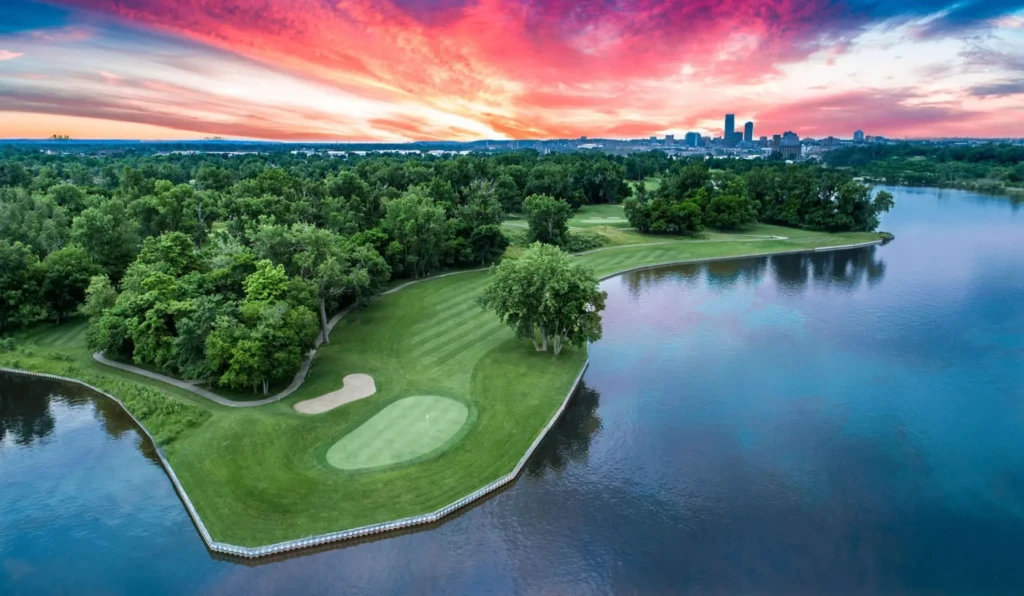



















































Perched along the Hudson River with the Manhattan skyline looming in the distance, Bayonne Golf Club stands as one of the most ambitious and visually striking golf course constructions in American history. Built on a former landfill and brownfield site, this private club in Bayonne, New Jersey, transformed 200 acres of industrial wasteland into a dramatic, windswept links that channels the spirit of the great courses of Ireland and Scotland. Designed by Eric Bergstol and opened in 2006, the club is a testament to human ingenuity and a golfer’s dream for those fortunate enough to secure an invitation.
This review draws on multiple visits, conversations with members, and analysis of the course’s architectural intent to provide a balanced, thorough assessment of Bayonne Golf Club’s layout, conditioning, challenge, and overall experience.
Course Overview and Design Philosophy
Bayonne Golf Club is often described as a “manufactured links,” and that label is accurate but sells short the sheer scale of the earthmoving involved. Eric Bergstol, a relatively unknown architect at the time, collaborated with developer Paul Fireman to create a course that would feel entirely natural, as if it had been shaped by centuries of wind and tide. The result is a non-traditional layout—no trees, firm fescue roughs, revetted bunkers, and undulating fairways that bleed seamlessly into the surrounding dunes. The course plays to a par-71, stretching from 5,100 yards at the forward tees to a formidable 7,100 yards from the back tees, with a slope rating that can reach 142 on the championship tees.
The design is unapologetically links-inspired, emphasizing ground game options, wind judgment, and creative recovery shots. The routing is a clever figure-eight that rarely plays the same direction twice in a row, constantly challenging the golfer to adjust to shifting wind conditions. The course’s centerpiece is its towering 100-foot dune—a constructed landmark visible from Manhattan—that hosts the first tee and the spectacular 13th green. This feature is the club’s signature, functioning as both a visual beacon and a strategic anchor.
Aesthetics and Ambiance
From the moment you pass through the security gate and wind your way up to the clubhouse, Bayonne Golf Club feels like a transatlantic escape. The rolling dunes, native sea grasses, and the distant sound of ship horns on the Hudson create an immersive sensory experience. The Manhattan skyline, particularly at twilight, provides a surreal juxtaposition: a classic links landscape framed by one of the world’s most famous urban backdrops.
The clubhouse continues the theme, built in the style of an Irish country manor with stone walls, dark wood, and understated elegance. The locker room and dining areas are intimate, encouraging camaraderie. While the club is unequivocally private and exclusive, the atmosphere is less stuffy than some of its Northeast counterparts, with a genuine focus on golf and fellowship.
Course Conditions and Maintenance
Bayonne’s maintenance practices are tailored to its links identity. Fairways and greens are primarily fescue, which creates firm, fast running surfaces—a rarity in the often soft, humid Northeast. The turf is kept lean, and the course is designed to play crisp and bouncy, even in summer. Greens are typically smooth and quick, running at 10-11 on the Stimpmeter daily, with subtle internal contours that demand precise approach placement and a deft putting touch.
The bunkering is particularly noteworthy. Revetted sod walls, built in the classic Scottish style, are not only visually striking but also highly strategic. They are deep and penal, often requiring a sideways or backward escape. The sand quality is excellent—fluffy enough to prevent fried-egg lies but firm enough to allow spin. The fescue roughs are wispy but punishing; a ball off-line can be found, but the resulting lie is often unpredictable, making it a genuine half-stroke penalty.
One minor critique: during peak summer, the fescue can become so dry and brittle that balls nestle down mercilessly, leading to some slow searches. The club has tried to balance playability with naturalism, but some members have grumbled about the inconsistency of lies in the rough. Overall, however, the conditioning is superb, and the course achieves its intended firmness most of the season.
Hole-by-Hole Highlights
While a full hole-by-hole tour would require more space, several standout holes define the Bayonne experience:
Hole 1 – Par 4, 425 yards: The opener sets the tone. From the elevated tee atop the massive dune, you drive down into a valley flanked by mounds and bunkers. The approach plays to a punchbowl green that accepts running shots. The view back toward the city is breathtaking.
Hole 4 – Par 3, 175 yards: A scenic one-shotter over a marshy inlet, with a shallow green guarded by a menacing pot bunker front-right. Wind plays tricks here, often knocking down a seemingly well-struck tee shot.
Hole 7 – Par 5, 580 yards: A classic risk-reward three-shotter that bends left around a waste area. The second shot must carry a cross-bunker to set up a short iron approach to an elevated, tiered green. The long hitters can reach in two if they challenge the corner, but the penalty for missing is severe.
Hole 13 – Par 4, 410 yards: The signature hole. You drive from the base of the great dune to a fairway that tilts hard right. The second shot climbs 40 feet uphill to a green tucked into the dune’s peak, with the city over your shoulder. Pars here feel like birdies.
Hole 17 – Par 3, 210 yards: A long, demanding par-3 played across a swale to a green with brutal false front and deep bunkers left. Into a headwind, this hole can require a driver for some.
Hole 18 – Par 5, 530 yards: A dramatic finisher with water down the entire left side. The fairway is wide but tilts toward the hazard, and the green is perched above a steep drop-off. Reaching in two is possible but fraught with danger; a layup leaves a nervy wedge over a bunker.
Playability and Challenge
Bayonne is not a course for the faint of heart. Wind is its primary defense; a 15-20 mph breeze is typical, and gusts can reach 40 mph, turning manageable holes into beasts. The firm ground forces players to think creatively—bump-and-run shots, low punches under the wind, and using slopes to feed the ball to the hole are essential skills. High-ball hitters and those reliant on spin will find the course very challenging.
For mid-to-high handicappers, the course can be daunting. Forced carries over fescue and lost balls are a real risk. However, the wide fairways provide ample room from the tee, and the lack of trees means recovery is possible from most misses if you can find the ball. The course is arguably best enjoyed by single-digit handicappers who can appreciate its nuance and have the arsenal to handle the wind.
Amenities and Service
The club is strictly private, with no public access. Members and their guests enjoy top-tier amenities: a well-appointed practice facility with a driving range, short game area, and putting green; caddies (strongly encouraged, and they are knowledgeable); and a full-service pro shop. The dining room serves excellent seasonal fare, and the clubhouse veranda offers panoramic views of the course, the river, and the Statue of Liberty.
Service is attentive and polished, befitting a club of this stature. Caddies are a highlight—many have looped here for years and can read the complex greens with uncanny precision. The exclusivity, however, means that access is limited, and the membership cost is substantial (reportedly in the high five figures for initiation, with annual dues in the five-digit range). This is a life-goal club for most, not an impulse join.
Overall Assessment
Bayonne Golf Club is a singular achievement: a links golf experience created from scratch in one of the most unlikely places on earth. Its architectural integrity, conditioning, and sense of place are undeniable. It challenges everything you know about American golf and rewards the thinking player. For its members, it offers an escape that feels miles from urban life, even as the Empire State Building looms.
Critics might argue that it lacks the organic evolution of true linksland—some of the mounding feels a touch manufactured, and the artificial elevation changes can be jarring. But these are minor quibbles in the context of the grand experiment. Bayonne succeeds wildly because it takes the core tenets of links golf—firmness, wind, and strategy—and executes them faithfully.
Rating Summary
| Criteria | Score (out of 10) | Comments |
|---|---|---|
| Design & Layout | 9.5 | World-class routing, exceptional use of terrain and wind; the figure-eight loop is brilliant. |
| Conditioning | 9.0 | Firm and fast fescue is a joy; occasional inconsistency in rough thickness is the only detractor. |
| Aesthetics & Ambiance | 9.5 | Unforgettable skyline views and authentic links feel; the great dune is iconic. |
| Challenge & Fairness | 8.5 | Demanding but fair for skilled players; high handicappers may suffer, but bail-out areas exist. |
| Amenities & Service | 9.0 | Beautiful clubhouse, top caddie program, and fine dining; access is an obvious limitation. |
| Overall Experience | 9.2 | A bucket-list course that lives up to the hype; a triumph of vision and engineering. |
Final verdict: Bayonne Golf Club is a must-play for anyone passionate about course architecture and the links ethos. It is not a casual round; it demands thought, skill, and adaptability. But those who rise to its challenge will be rewarded with one of the most memorable golf experiences in the United States. If you receive an invitation, accept without hesitation.