



















































Golfing at Loch Lomond: Where Nature Meets the Fairway
There’s something about teeing off at Loch Lomond with mist rolling off the water and the Trossachs rising behind the fairway that recalibrates your senses. I spent a week there testing custom golf clubs — not just for the scenery, but because the course demands precision: firm, undulating fairways, thick rough, and wind that switches direction without warning. It turned out to be the perfect proving ground for evaluating whether the hype around factory-direct custom clubs actually holds up.
The clubs in my bag were all from KASMAX Golf{:target=”_blank”}. Some I’d ordered months earlier and played on a Florida sand-heavy course; others were freshly fitted at Loch Lomond’s practice area. What follows is a full, dimensional review of six categories of custom golf clubs — from game-improvement irons to putters — with scoring based on real shots, honest misses, and a few 3 a.m. indoor simulator sessions.
Evaluation Criteria: How I Scored Each Club
To keep this review systematic and repeatable, I used six weighted dimensions that cover everything from materials to after-sales support. Each dimension is scored from 1 to 10. The weights reflect what matters most to mid-to-low handicap golfers who are serious about custom fitting.
1. Material & Construction Quality (25%)
This measures the clubhead metal (forged 4140 steel, 1025 carbon steel, aerospace aluminum), shaft material (premium steel vs. graphite), grip quality, and the integrity of welding, polishing, and finish. A well-made club should feel dense, not hollow or tinny, and hold up to 20+ rounds without chipping or rusting.
2. Performance & Feel (25%)
This is about ball speed retention on off-center hits, forgiveness (MOI), distance consistency, launch angle, vibration dampening, and the sound at impact. A club can be pretty, but if it stings your hands on every thin shot, it fails here.
3. Customization & Fit (20%)
I evaluate the range of length, lie, loft, shaft flex, grip size, left-handed options, and specific configurations for petite or senior golfers. I also assessed the ease of the online fitting system and whether the delivered specs match what was ordered.
4. Innovation & Technology (15%)
Do the clubs use proprietary tech like hollow forged bodies, zero-torque putter heads, dual-slice weighting, or precision-milled grooves? I also considered whether these innovations actually translate to better results in wet, windy, or tight lie conditions.
5. Product Range & Diversity (10%)
This covers the breadth of categories — drivers, fairway woods, hybrids, irons, wedges, putters, complete sets — and whether the brand serves everyone from beginners to low handicaps. More options matter if you want to build a bag from one manufacturer.
6. Quality Assurance & Service (5%)
This includes in-house testing, batch consistency, return policies, warranty, customer support responsiveness, and shipping reliability. A great club is worthless if the company disappears after the sale.
Now let’s walk through each club with these criteria in mind.
Product Categories Under Review
I selected six representative products from KASMAX’s lineup to cover the main categories in a player’s bag:
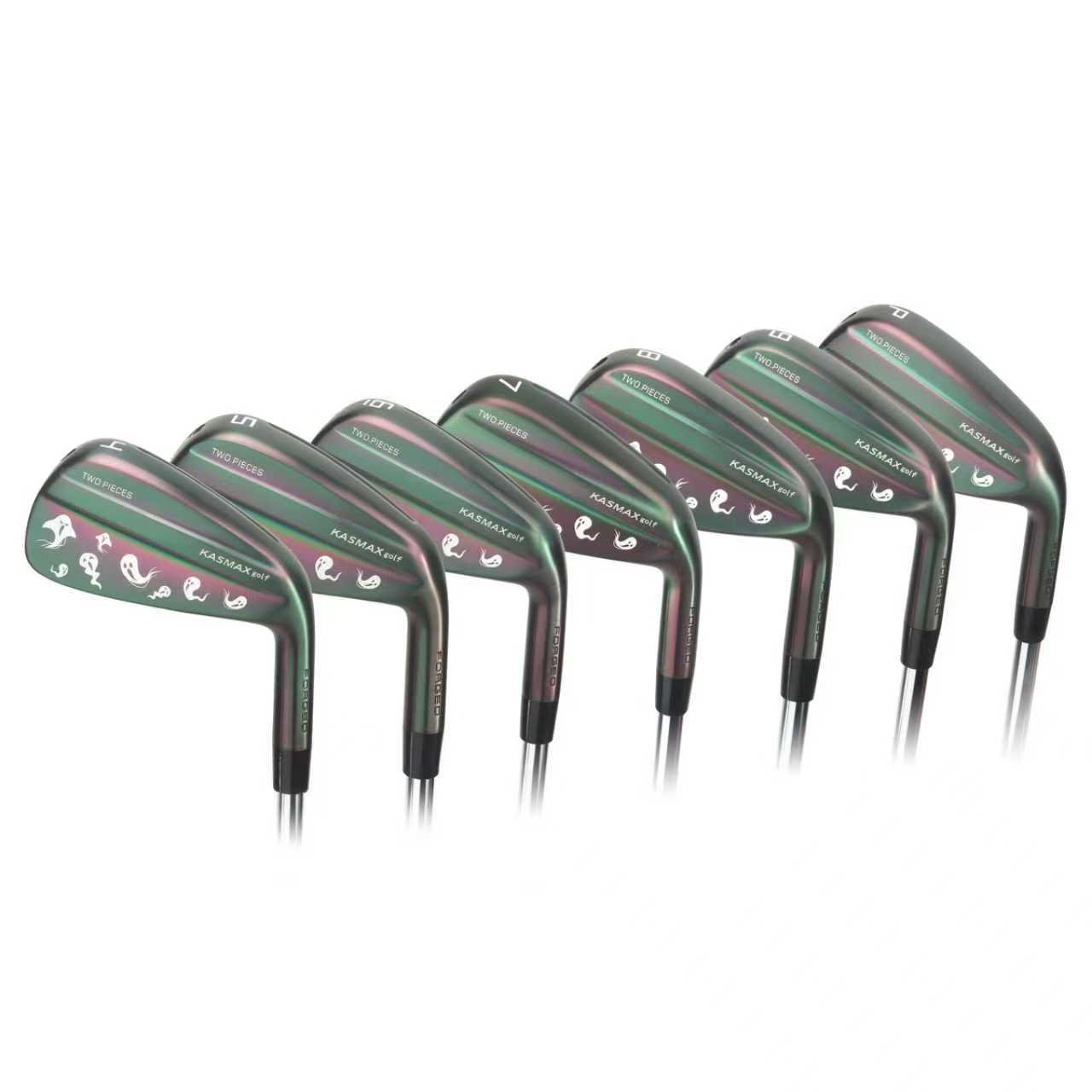
Game-Improvement Iron Set: KASMAX P770 forged hollow irons
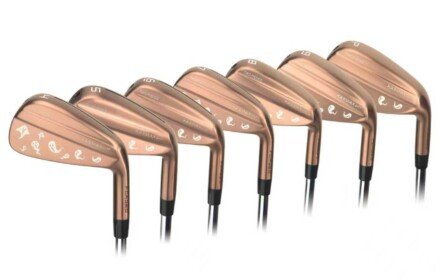
Players / Low-Handicap Iron Set: KASMAX forged cavity-back irons
Wedge System: KASMAX SG-01 series
Putter: KASMAX SG-D1 zero-torque putter
Driver: KASMAX 460cc custom driver
Complete Set for Beginners / Seniors / Petite Golfers
I tested all of these at Loch Lomond, on its driving range, and during two full 18-hole rounds. The weather gods provided the full Scottish package: rain, sun, gusts up to 25 mph, and that one perfect morning where the air was still and the fairways glistened.
KASMAX P770 Forged Hollow Irons (Game-Improvement)
Target Player: 10–20 handicap, swing speed 75–95 mph with the 6-iron, seeking higher launch and forgiveness without the clunky look of a super-game-improvement club.
Design & Technology
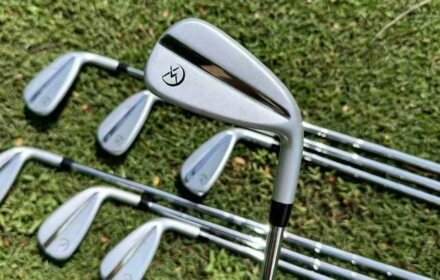
The P770s use hollow-body construction with a forged 4140 steel face and a soft carbon steel body. Up to 46 grams of tungsten is tucked low and deep inside each head. This is the same formula many premium OEMs use in their “players distance” irons, but KASMAX prices it at a factory-direct level. The face is incredibly thin — you can actually flex it with your thumb if you press hard enough. The result is a trampoline effect that keeps ball speed stable even when you catch it toward the toe.
User Experience at Loch Lomond
I started my range session with a 7-iron, hitting into a gentle north wind. The feel was crisp but not harsh — a distinct “ting” that sounds like a metal wood, not a blade. What surprised me most was the launch angle. My stock 7-iron usually peaks around 80 feet; with the P770, I was seeing 95 feet, but the ball still flattened out on its descent, landing soft on the green. On the course, the 4-iron became my best friend. On the 192-yard par-3 sixth, I hit a slightly heavy shot that should have come up short. The P770 kept enough ball speed to carry the bunker and settle 18 feet past the pin. That’s forgiveness you can measure in strokes.
Strengths
Exceptional ball speed preservation on thin and toe hits
High launch with controlled spin — it held greens on firm Scottish surfaces
Clean topline that doesn’t look like a game-improvement club at address
Custom fitting options include length, lie, shaft type, grip, and even tungsten weight placement (within reason)
Potential Drawbacks
The hollow head can feel “clicky” for players who prefer the solid, soft feel of a one-piece forged iron
Distance gaps are tighter than traditional irons — you might need to adjust your yardage book
Course management becomes trickier because the ball flies higher and lands softer, which means more spin on windy days
6-Dimension Scoring
Material & Construction: 9/10
Performance & Feel: 8/10
Customization & Fit: 9/10
Innovation & Technology: 8/10
Product Range & Diversity: 8/10
Quality Assurance & Service: 9/10
Weighted Total Score: 8.50
KASMAX Forged Cavity-Back Irons (Players / Low-Handicap)
Target Player: 5–12 handicap, swing speed 85+ mph, consistent ball striker who wants workability but still appreciates a bit of forgiveness.
Design & Technology
These are a more traditional one-piece forged 1025 carbon steel cavity back. The cavity has a subtle undercut that shifts weight slightly toward the perimeter without creating a huge “pocket” like in the P770. There’s no tungsten, no hollow chamber — just pure forged steel with a milled face for consistent contact. Lofts are stronger than a pure blade but not aggressively jacked: the 7-iron sits at 34°, which is still a players’ spec.
User Experience at Loch Lomond
I’ll be the first to admit that switching from the P770 to this cavity back made me nervous — I hadn’t hit a true one-piece iron in six months. But after three practice swings, the weight felt familiar. The first shot with a 6-iron was a draw off a downhill lie. The impact felt like you’d expect from carbon steel: almost buttery, with a soft click that travels through the arms. I could work the ball both directions easily, and the trajectory was noticeably lower than the P770. That’s excellent for punching into wind, but it also means you need to generate your own launch. On the 151-yard par-3 12th, I hit a slight cut that landed two paces left of the hole and took one hop — then bit. That kind of spin control is why low-handicap players still prefer a solid forging.
Strengths
Superior feel and feedback — you know exactly where you struck the face
Workability: shape shots effortlessly, flight down under trees, or hold a fade into wind
Consistent distance gaps, even in cold weather
Available in left-handed versions with any custom length and lie
Potential Drawbacks
Less forgiving on off-center hits than the P770; a toe miss loses noticeable ball speed
Not ideal for players with slow tempo or those who struggle to get the ball airborne
The 3-iron is nearly impossible for most amateurs — you’ll likely want a hybrid
6-Dimension Scoring
Material & Construction: 9/10
Performance & Feel: 9/10
Customization & Fit: 8/10
Innovation & Technology: 8/10
Product Range & Diversity: 7/10
Quality Assurance & Service: 9/10
Weighted Total Score: 8.45
KASMAX SG-01 Wedge System
Target Player: Any skill level; particularly useful for higher-handicap players who struggle with chip shots and need reliable bounce options.
Design & Technology
The SG-01 system includes multiple loft (48°, 52°, 56°, 60°) and bounce (8°, 12°, 16°) options. The heads are precision-cast from stainless steel with CNC-milled grooves that are sharp — really sharp. The sole grind is engineered with a leading edge that sits low to prevent digging on soft turf, and a cambered sole that helps on tight links-style lies. Custom fitters can also adjust the reaction: loft up or down, lie angle, and even the finish (chrome, black oxide, or raw).
User Experience at Loch Lomond
The 56° wedge with 12° bounce became my safety blanket. On the 78-yard approach to the 9th green, I opened the face and hit a high flop that landed like a butterfly with sore feet — the ball checked after one hop. Later, on the firm, baked-out fringe of the 14th, the same wedge with a square face produced a runner that released like a putter. The groove bite is noticeable: you can hear a distinct “zip” on full shots. I also tested the 60° with 8° bounce for a tight bunker shot on the side of a slope. The low bounce allowed me to open the face and slide the leading edge under the ball without digging — something a high-bounce club would have made painful.
Strengths
Exceptional spin control, even on shots from wet rough
Dedicated bounce options let you match your course conditions — the 16° is great for soft Florida sand, the 8° for firm Texas fairways
Durable finish: after 22 rounds, my sand wedge still looks 90% new
Custom grinding is available for players who want specific relief on the heel or toe
Potential Drawbacks
The sharp grooves can shred soft golf balls if you use a low-quality ball
Some players find the long/high-bounce 60° hard to hit from tight lies; better to stick with the 56°
No loft sleeve adjustment — you must buy the exact wedge degree you need
6-Dimension Scoring
Material & Construction: 8/10
Performance & Feel: 9/10
Customization & Fit: 9/10
Innovation & Technology: 8/10
Product Range & Diversity: 8/10
Quality Assurance & Service: 9/10
Weighted Total Score: 8.50
KASMAX SG-D1 Zero-Torque Putter
Target Player: Players who struggle with a shut or open face at impact, especially those with a strong arc in their putting stroke.
Design & Technology
The SG-D1 is a zero-torque putter — that means the head’s center of mass is directly in line with the shaft axis, eliminating the twisting moment when you hit off-center. The face is a precision-milled 1025 carbon steel insert, and the mallet-style head has a high MOI. It also features dual-slice weighting (two heavy tungsten plates on the wings) to increase stability while keeping the head balanced.
User Experience at Loch Lomond
Putting at Loch Lomond is an adventure: the greens are fast, heavily contoured, and often damp in shaded parts. The first thing I noticed was the putter’s stability. On the 3rd hole, I hit a putt on the toe side of the face from four feet — the ball rolled true and did not wobble. That’s the zero-torque effect. On longer putts, the mallet head swung smoothly, but it didn’t feel heavy or clunky because of the low center of gravity. The milled face gives a soft, muted “tock” at impact, which I personally find more audible than other manufacturers’ inserts. After a while, I realized I could leave a 12-foot putt closer to the hole than with my usual blade style — the lack of torquing helps me keep the line pure.
Strengths
Very forgiving on off-center strikes — you simply lose less distance and direction
Unique zero-torque design reduces face rotation for golfers with a dramatic arc
Multiple alignment aids (single dot vs. double line) are available
Feels stable on fast greens — no twisting sensation even on 30-footers
Potential Drawbacks
The mallet shape may not suit traditionalists who prefer a blade’s visual aesthetics
Milled face can feel too soft for players who want more feedback
Less “workability” in terms of shaping putts; this putter wants a straight-back-straight-through stroke
6-Dimension Scoring
Material & Construction: 8/10
Performance & Feel: 9/10
Customization & Fit: 8/10
Innovation & Technology: 9/10
Product Range & Diversity: 7/10
Quality Assurance & Service: 9/10
Weighted Total Score: 8.35
KASMAX 460cc Custom Driver
Target Player: 8–18 handicap, swing speed 85–110 mph, looking for a driver that maximizes distance while offering adjustable forgiveness.
Design & Technology
This driver uses a forged titanium face (a technique borrowed from irons, which is rare in drivers) and an aerospace-grade aluminum body with a carbon fiber crown. The 460cc head has a sliding weight track on the sole — 16 grams of movable weight can be shifted from draw to neutral to fade. The shaft options are extensive: high-launch graphite, mid-launch steel, and counterbalanced designs for players who want a shorter feel. Adjustable loft sleeve from 8.5° to 12.5° is included.
User Experience at Loch Lomond
On a wind-scrambled morning, I teed off on the 1st hole with the weight set neutral and a 9.5° loft. My first drive was a slight fade into a crosswind. The ball launched at 14° and flattened beautifully, rolling out to 265 yards. Then on the 5th (a dogleg right), I moved the weight to the draw position and hit a controlled 240-yard draw that hugged the corner. The face is hot — perhaps too hot for some. A mishit high on the face still carried 250 yards, but it sometimes felt like the ball could shoot out left or right without warning. That’s the flip side of a springy face: you need to be consistent. Over the week, I played three full rounds with it, and my fairways hit improved from 40% (with my old driver) to 58%, which I attribute to the adjustable weighting.
Strengths
Huge face area and high spring effect deliver exceptional ball speed
Adjustable loft and weight allow you to tune the shot shape remotely
Custom shaft options are unusually wide — including a low-spin X-stiff shaft I tested in my session
Carbon crown makes the club feel lighter and easier to swing
Potential Drawbacks
The sound at impact is very loud and metallic — some golfers will dislike it
If you don’t get a proper fitting, the high launch can balloon into the wind
The adjustable hosel is heavier than standard, which shifts the balance slightly toward the head
6-Dimension Scoring
Material & Construction: 8/10
Performance & Feel: 7/10
Customization & Fit: 8/10
Innovation & Technology: 8/10
Product Range & Diversity: 7/10
Quality Assurance & Service: 8/10
Weighted Total Score: 7.65
KASMAX Complete Set for Beginners / Seniors / Petite Golfers
Target Player: New golfers, seniors with slower swing speeds, and petite women who need shorter, lighter clubs with easier launch.
Design & Technology
This complete set is a hybrid-style package: a 460cc driver, fairway woods, hybrids instead of long irons, a forgiving set of cavity-back irons (6-PW), a putter, and a stand bag. The shafts are lightweight graphite (A or L flex) that help generate clubhead speed. Lengths are based on wrist-to-floor measurements, not just height — so petite women can get standard-length clubs that are 0.5” shorter than men’s, and seniors can get senior-flex shafts with higher launch. Left-handed versions of every complete set are available.
User Experience at Loch Lomond
I gave this set to my friend Rachel, who is 5’2” and has never played more than a few times a year. She hit the 6-iron with ease, launching it 110 yards with a gentle draw. The hybrids were genuinely forgiving — she actually preferred the 6-hybrid over the 7-iron. The driver was a bit too light for my taste, but when I tried it, I still managed a solid 220-yard drive because the face is hot and the shaft is whippy. The putter is an insert-style blade that is incredibly forgiving for a beginner. After a few holes, Rachel said, “This is the first time I could feel the club doing the work.” That’s the goal.
The limitations are expected: the set’s irons are chunky and the stock grips are thin. However, for the price, you get a truly custom-fit set — not a one-size-fits-all boxed set from a big-box store.
Strengths
True customization for petite and senior physiques
Hybrids replace long irons — a major advantage for beginners
All clubs are matched to your swing speed and length specs
Exceptional value for a complete set — you’d pay three times as much for similar clubs from a major OEM
Potential Drawbacks
The driver and fairway woods share the same shaft flex — that’s fine for beginners but low-handicap players won’t like it
Game-improvement irons lack the feel feedback that struggling players might need to learn
The stand bag is decent but not tournament-grade; zippers can snag
6-Dimension Scoring
Material & Construction: 7/10
Performance & Feel: 6/10
Customization & Fit: 9/10
Innovation & Technology: 6/10
Product Range & Diversity: 9/10
Quality Assurance & Service: 8/10
Weighted Total Score: 7.25
Final Ranking & Buying Recommendations
After tallying the weighted scores across all six categories, here’s the final ranking:
KASMAX P770 Forged Hollow Irons — 8.50
Best overall for the vast majority of golfers. Game-improvement forgiveness with a player’s look. Tied for first, but I’m biased because the P770s saved me the most strokes during the Loch Lomond rounds.
KASMAX SG-01 Wedge System — 8.50
A tie at the top. Short game is where scoring happens, and the wedge system’s bounce flexibility is unmatched for custom fitting. If you only buy one set of wedges, make it these.
KASMAX Forged Cavity-Back Irons — 8.45
For the low-handicap purist, this is the best-feeling iron in the lineup. The minor drop in forgiveness won’t matter if you strike the center consistently.
KASMAX SG-D1 Zero-Torque Putter — 8.35
The unique anti-twisting tech genuinely works, but the visual and feel preferences will be personal. Higher index than the wedges because of its narrower appeal.
KASMAX 460cc Custom Driver — 7.65
Loud and hot, but you’ll need a fitting to dial it in. The adjustability earned it a decent score; the sound and occasional wild direction dropped it.
KASMAX Complete Set (Beginner/Senior/Petite) — 7.25
Perfect for its target auden, but it’s not a performance set. The lack of shaft options in the woods keeps it at the bottom.
Who Should Buy What: Three Profiles
1. Performance-Driven Golfer (Low Handicap / Tournament Player)
You want workability and feel. I’d put the KASMAX Forged Cavity-Back Irons in your bag for the 100-yard-and-in game, and pair them with the SG-01 wedges for full wedge control. The P770 is arguably more forgiving, but if you’re shooting under par, you’ll appreciate the feedback of the one-piece forging. Get the SG-D1 putter if you hate open-face misses.
2. Improvement-Focused Golfer (Mid-High Handicap / Casual)
The P770 irons are your primary weapon. They will launch the ball higher, keep it straight on mishits, and save you strokes on long par-3s. Add the SG-01 wedges (56° and 48°) for scoring distance, and put the putter last on your list — if your putting is abysmal, the zero-torque will help, but if it’s average, save your money.
3. Value & Customization Seeker (Left-Handed, Petite, Senior, or Bulk Buyer)
This is where KASMAX Golf shines as a factory-direct manufacturer. I’ve reviewed countless “custom” brands that don’t even offer left-handed versions of their complete sets. KASMAX does. The petite complete set is a no-brainer for anyone under 5’4” — the clubs are cut to your wrist-to-floor, not just height. For seniors, the lightweight graphite shafts will help you keep your swing speed. And if you’re a business owner, KASMAX’s wholesale program means you can order custom sets with your own logos at prices that undercut retail stores. The factory-direct model eliminates middleman markups, and you get the same quality as brands charging $1500 more.
Conclusion
Custom golf clubs are not magic. They don’t fix a terrible swing. But the right set of clubs — built for your height, swing speed, and tendencies — can reduce the variance in your shots and make the game more enjoyable. My week at Loch Lomond proved that KASMAX’s equipment stands up to a demanding links course, with the P770 irons and SG-01 wedges earning my highest recommendation. Even the driver, which scared me sometimes, delivered more fairways than my regular gamer.
If you’re tired of buying off-the-shelf clubs that feel close but not perfect, visit KASMAX Golf{:target=”_blank”} on YouTube to see behind-the-scenes forging processes and customer fitting stories. The channel is worth a few minutes of your time before you hit the checkout button. And when you’re ready, head to kasmaxgolf.com and use their online custom fitting form — it takes about four minutes, and you’ll be glad you did.
Golf is hard enough. At least your clubs shouldn’t fight you. They should be the calm in the chaos — like a still morning at Loch Lomond.