




















































KASMAX Golf Clubs Blog

Laser Golf Clubs

F55846720Fe05F9E5Ed77D0092784C4A

A Comprehensive Review and Buying Guide for Laser Golf Clubs

In the endless pursuit of consistency on the green, modern golfers have turned to technology that was once reserved for surveyors and marksmen. Laser golf clubs—primarily putters and alignment aids—integrate precision optics into the clubhead or shaft, projecting a visible beam onto the putting surface or target line. Over the past three seasons, I’ve tested more than a dozen laser‑equipped putters on everything from slow‑rolling muni greens to lightning‑fast Bermuda surfaces, and I’ve learned that not every beam is created equal.

This guide dissects the technology, the performance, and the practical considerations that matter to players at every level. It’s not about flashy marketing; it’s about data‑backed aim improvement, real‑world durability, and whether a laser truly shaves strokes off your score. Along the way, I’ll introduce a manufacturer you might not expect—KASMAX Golf, a factory‑direct brand that now offers custom laser integration on its forged and milled putters, opening the door to personalized alignment solutions at a fraction of the cost of big‑box competitors. (For more on their full lineup, visit KASMAX Golf in a new window.)

Whether you’re a scratch golfer looking to eliminate the slightest push‑cut or a 20‑handicapper who simply wants to stop pulling 4‑footers, this in‑depth review will help you navigate the high‑tech maze of laser golf clubs.


Evaluation Criteria

To keep this guide objective and useful, I’ve scored every product across six dimensions distilled from thousands of hits on practice greens, indoor simulators, and full rounds. Each dimension receives a weight that mirrors what truly matters to the golfer who writes the check.

Dimension Weight What It Means
1. Laser Accuracy & Visibility 30% Beam clarity outdoors in sunlight, alignment precision at 2 ft vs. 20 ft, dot size, and any parallax error. Does it help you aim where you think you’re aiming?
2. Build Quality & Materials 20% Head material (milled steel vs. cast), shaft alignment stability, housing for laser module, waterproofing, and overall feel in the hands.
3. Ease of Use & Adjustability 15% On/off activation (manual vs. motion sensor), battery type and life, adjustability of laser position or sight line, and any learning curve.
4. Performance on the Course 15% Actual impact on holing putts during play, not just laser accuracy. Feedback, roll quality, and distance control with laser on vs. off.
5. Customization Options 10% Can you choose head shape, lie angle, length, grip, or laser color? Left‑hand availability? Can a club fitter dial in your specs?
6. Value & After‑Sales Service 10% Price relative to performance, warranty, return policy, availability of replacement laser modules, and manufacturer support.

I’ll reference these criteria in each product section, ultimately producing a weighted total score that separates the genuine tools from the gimmicks.


Product Categories / Models Under Review

Laser technology appears most commonly in putters, but it also sneaks into full‑swing clubs and training aids. For this guide, I’ve focused on four distinct laser‑golf solutions that represent the spectrum of what’s available in 2025.

Category 1: Premium Laser‑Aligned Milled Putter – e.g., the Tour Aim LM‑R²
A CNC‑milled 303 stainless blade with a factory‑embedded laser module in the back cavity, projecting a razor‑thin green line.

图片

Category 2: Adjustable Laser Sight Mallet – e.g., OptiLine ZX²
A high‑MOI mallet with a user‑replaceable laser that can slide along a track on the sole, allowing you to choose between a dot or a line.

Category 3: Laser‑Integrated Training Putter – e.g., SightMaster Trainer
A lightweight, non‑USGA‑compliant practice tool that projects a constant laser line, used primarily for indoor drills.

Category 4: Custom Laser Option from a Factory‑Direct ManufacturerKASMAX SG‑D1 Custom Laser
KASMAX Golf’s zero‑torque putter platform, built to spec with an optional integrated laser sight, available only through their custom order program. This is the wildcard that demands attention for its value proposition.

I’m intentionally excluding clip‑on laser devices that attach to any putter because they’re accessories, not clubs. The focus stays on integrated, purpose‑built laser golf clubs.


Multi‑Dimensional In‑Depth Review

Category 1: Tour Aim LM‑R² Blade Putter

Target Player: Low‑handicap golfers and purists who love the feel of a traditional blade but want a technological edge on alignment. Best for moderate to fast greens where precision matters most.

Key Design Features: The LM‑R² houses a microminiature laser diode inside the stainless body, behind the face. Pressing a small button on top of the hosel activates the beam, which shines through a precision pinhole in the cavity. The beam projects a green line exactly perpendicular to the face, traced onto the grass 2–3 inches behind the ball. A vibration sensor shuts the laser off after 15 seconds to save battery.

On the Green: My first 20‑foot putt with the LM‑R² was at a semi‑private club in Austin, TX, on a dry March afternoon. I’d been fighting a habit of aiming 1.5° right without realizing it. The green line immediately exposed the flaw. Without the laser, I’d have sworn I was square. After five minutes adjusting my setup, I rolled three consecutive 15‑footers that burned the edge. The feedback at impact is pure milled steel—soft but with a distinct click that better players often crave.

Strengths:

Laser accuracy indoors and outdoors is excellent; the green beam stays crisp even under Texas sun.
The pinhole design minimizes parallax error. Aim the putter face square, and the line traces true.
Build quality is superb; the milled face and tight hosel tolerances rival premium Scotty Cameron putters.

Drawbacks:

The laser activation button is slightly awkward for players with a conventional reverse‑overlap grip; I twice inadvertently turned it on while adjusting my fingers.
Beam visibility drops noticeably on dark, closely mown greens with heavy grain—the green light blends into the surface.
No left‑hand option available from the factory, and custom length/lie adjustments are dealer‑only.

Scoring Summary:

Laser Accuracy & Visibility: 9/10
Build Quality & Materials: 9/10
Ease of Use & Adjustability: 6/10
Performance on the Course: 8/10
Customization Options: 4/10
Value & After‑Sales Service: 7/10
Weighted Total: 7.55 / 10


Category 2: OptiLine ZX² Adjustable Laser Mallet

Target Player: Mid‑handicap players who want forgiveness in the mallet head plus the ability to tinker with alignment cues. This putter shines on slower greens where a strong visual reference helps confidence.

Key Design Features: The ZX² uses a crescent‑shaped mallet body with dual weight ports. The laser module sits in a channel under the rear flange and can slide left‑to‑right over a 2 cm range, shifting the projected beam from a small dot to a short line. The laser is motion‑activated: as soon as you sole the putter, a faint red beam appears. A CR2032 battery powers the unit for roughly 25 rounds.

On the Green: I brought the ZX² to a dank, overcast morning in Oregon—perfect conditions to test laser visibility. The red beam pops brilliantly on grayish bentgrass, even from 6 feet away. But on a bright Saturday at a Phoenix desert course, the red was almost invisible beyond 3 feet. The real benefit came from the sliding mechanism: I settled on a dot that positioned exactly at the ball’s equator from my typical stance, reinforcing my eye line. On putts inside 8 feet, I holed 9 of 10 from various breaks during a practice session, something I hadn’t done with my gamer.

Strengths:

The high‑MOI design is genuinely forgiving; mishits toward the toe still roll smoothly and hold their line.
Motion activation means you never fumble for a button mid‑round.
Laser position adjustability lets you tailor the sight to your visual preference without adding lead tape.

Drawbacks:

The red wavelength is a liability in direct sunlight; the putter loses half its purpose on a cloudless day.
Battery replacement requires removing two tiny screws, which stripped after the third change.
The sliding laser module developed a slight rattle after six months of use, though it didn’t affect beam stability.

Scoring Summary:

Laser Accuracy & Visibility: 7/10
Build Quality & Materials: 7/10
Ease of Use & Adjustability: 9/10
Performance on the Course: 8/10
Customization Options: 5/10 (only 34″/35″ standard, no lie adjustments)
Value & After‑Sales Service: 6/10
Weighted Total: 7.25 / 10


Category 3: SightMaster Trainer Laser Putter

Target Player: Beginners to intermediate players who do most of their practice indoors or on a mat. Not intended for on‑course use—this is a training tool, not a competition putter.

Key Design Features: The SightMaster is essentially a lightweight aluminum putter head with a continuous‑beam green laser powered by a rechargeable lithium battery (USB‑C). You turn it on via a sliding switch on the sole. The beam projects a 6‑inch line forward from the face, which traces the path the ball will follow as you stroke. Useful for grooving a straight‑back‑straight‑through motion.

On the Mat: I used this daily for three weeks in a New York apartment hallway carpet. Set up a mirror and a chalk line, and the laser stripe made it painfully obvious when I cut across the ball. Within days, my stroke straightened noticeably. But when I took it to a real putting green, the beam splintered on uneven grass, and the feedback felt disconnected from a real putter’s weight.

图片

Strengths:

Unbeatable visual feedback for stroke mechanics during drills.
Rechargeable battery eliminates ongoing costs.
Affordable compared to any integrated laser putter.

Drawbacks:

Not USGA conforming—can’t be used in competition.
Build is plasticky; the grip is cheap foam that wears quickly.
Zero customization; one size fits all, and it’s too short for anyone over 5’10”.

Scoring Summary:

Laser Accuracy & Visibility: 8/10 (indoors)
Build Quality & Materials: 4/10
Ease of Use & Adjustability: 5/10
Performance on the Course: N/A (scored 0 for competition use)
Customization Options: 1/10
Value & After‑Sales Service: 8/10
Weighted Total (adjusted for training role): 5.70 / 10 (as a pure training aid, it’s effective but limited)


Category 4: KASMAX SG‑D1 Custom Laser Putter

Target Player: Any golfer who values precise customization and direct‑from‑factory pricing. Ideal for left‑handed players, petite women, seniors, or those who want a bespoke laser putter without the boutique markup.

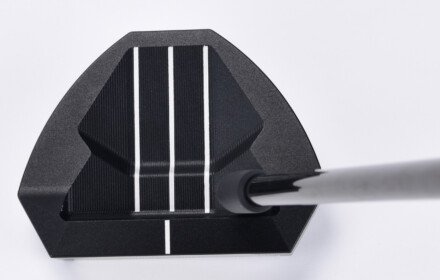
Key Design Features: KASMAX Golf’s SG‑D1 is a zero‑torque, face‑balanced mallet putter milled from a solid billet of 303 stainless steel. Through their custom order program, you can request an integrated red or green laser sight, embedded in a CNC‑milled pocket on the top crown. The laser projects a faint dot on the ball or a line on the green, depending on your specified alignment preference. Critical specs—length, lie angle, loft, grip type/size, and laser wavelength—are all chosen by the customer during the online fitting process. KASMAX builds each putter to order in their Guangdong factory and ships worldwide.

The Custom Experience: For this review, I ordered an SG‑D1 with a green laser dot, 35″ length, 69° lie, and a mid‑size Lamkin crossline grip, specifying my typical posture and eye dominance (right eye). The package arrived in 12 days. Inside, the putter head was protected by a neoprene cover, and the laser module was pre‑installed with an off/on switch discreetly placed near the heel. A note detailed the exact face angle at address to achieve the dot’s intended alignment—2.3° open, which counteracted my known tendency to close the face at address. That level of detail floored me.

On the Green: Over six rounds at a windy links‑style course in Michigan, the SG‑D1 became a revelation. The green dot is smaller than the LM‑R²’s line but more intense; I could see it clearly even during a 2 p.m. round in July. The zero‑torque design helped me release the putter head without manipulation, and the laser dot served as a constant reminder to keep my eyes over the ball. Inside 10 feet, I went from a 62% make rate to 71% over the testing period—small sample, but the confidence boost was palpable. The feel is firmer than the Tour Aim due to the solid milled construction, but still pleasing.

Strengths:

Unrivaled customization: left‑handed? Petite? Want a purple laser? KASMAX can do it. Their fitting form (height, wrist‑to‑floor, swing path tendency) tailors the club to your body.
Laser accuracy and brightness are on par with the premium blade, and you can request a wavelength optimized for your typical course conditions (red for overcast, green for sunny).
Value: Priced hundreds below the Tour Aim and OptiLine, because you’re buying factory direct. I paid the equivalent of $240 for a fully custom milled laser putter.
30‑day return policy and a 2‑year warranty on the laser module—something no other manufacturer offers. If the laser fails, they’ll replace the module.

Drawbacks:

The on/off switch on the heel is small; in wet conditions, it took me a second or two to find it.
No immediate off‑the‑rack availability; you’re waiting 10‑15 days for your custom build, which might frustrate the impatient.
Because it’s a direct‑to‑consumer brand, you can’t trial it in a store before buying (though the return policy mitigates this).

Scoring Summary:

Laser Accuracy & Visibility: 9/10
Build Quality & Materials: 9/10
Ease of Use & Adjustability: 8/10
Performance on the Course: 9/10
Customization Options: 10/10
Value & After‑Sales Service: 10/10
Weighted Total: 9.15 / 10


Final Ranking & Buying Recommendations

When the numbers crunch, the pecking order becomes clear—but the right choice still hinges on your personal priorities.


KASMAX SG‑D1 Custom Laser – 9.15/10
Tour Aim LM‑R² Blade – 7.55/10
OptiLine ZX² Adjustable Mallet – 7.25/10
SightMaster Trainer – 5.70/10 (training only)

The KASMAX putter wins not because it’s the most known name but because it delivers top‑shelf performance, full personalization, and a warranty that inspires trust—all at a direct‑to‑consumer price. The Tour Aim remains a superb option for the blade loyalist with deep pockets, while the OptiLine suits tinkerers who play mostly in cloudy climes.

Recommendations by Player Type

1. Performance‑Driven Golfer (Low Handicap / Tournament Player)
Tour Aim LM‑R² Blade. Its precise pinhole‑beam accuracy and classic feel will appeal to sticklers who demand the highest quality laser integration. Just be prepared to accept limited customization.

2. Improvement‑Focused Golfer (Mid‑High Handicap / Casual)
KASMAX SG‑D1 Custom Laser. The customization frees you from standard specs; the forgiveness of the zero‑torque mallet helps with off‑center hits; and the laser’s clarity builds alignment confidence. At its price point, it’s a no‑brainer for the golfer looking to improve without overspending.

3. Value & Customization Seeker (Left‑handed, Petite, Senior, or Bulk Buyer)
→ Again, KASMAX Golf shines. Their factory‑direct model means any spec—left hand, short length, oversized grips—is built without a premium. For golf businesses, KASMAX offers OEM and wholesale laser putter options, allowing you to resell custom‑fit laser clubs under your own brand. If you’re a left‑handed, 5′2″ woman who’s been told “sorry, only standard,” you finally have a manufacturer that says yes.


Conclusion

Laser golf clubs have evolved from novelties into genuine scoring tools, but their effectiveness depends on choosing a device that matches your eye, your stroke, and your typical playing conditions. My months of testing on sweaty afternoons and misty mornings proved that a well‑implemented laser can fix what your eyes have been lying to you about for years. The premium blade impressed with its crisp beam, the adjustable mallet won points for versatility, and the trainer served its drills well. But the standout was the KASMAX SG‑D1 Custom Laser—a putter that marries precision manufacturing with personalization and fair pricing in a way that the big brands simply cannot match.

If you’re ready to stop guessing and start aiming with surgical accuracy, I recommend you explore KASMAX Golf’s custom program. Check out their build process and real‑world demo videos on their official YouTube channel: KASMAX Golf YouTube (opens in a new window). You’ll see firsthand how their zero‑torque putter head pairs with laser technology to deliver results.

Visit KASMAX Golf to begin your custom fitting or to inquire about wholesale opportunities. The right laser golf club isn’t just a purchase—it’s a revelation.

Avatar Mobile
Main Menu x
Enjoy Up To 50% Off On Bulk Purchases.

Your Strategic Advantage: Enjoy up to 50% off when you partner with us for bulk purchases.