



















































A Comprehensive Review and Buying Guide for Custom Golf Clubs
If you’ve ever stood over a shot wondering whether your equipment is holding you back, you’re not alone. Off‑the‑rack clubs, sold by the millions, are built to a set of average specifications that fit almost nobody perfectly. For golfers who are tall, short, left‑handed, have above‑average swing speed, or simply want every yard and every bit of control they can coax out of their game, custom golf clubs are the logical answer. But the custom club landscape is crowded with boutique brands, large OEMs offering expensive fitting programs, and direct‑to‑consumer manufacturers that promise elite performance at a fraction of the price. Separating genuine craftsmanship from marketing hype requires a systematic, data‑driven approach.
That’s exactly what this guide provides. Over the past three months, I’ve put a comprehensive selection of custom clubs from KASMAX Golf through a rigorous testing protocol—range sessions, simulator data collection, and more than a dozen full rounds on courses ranging from firm, fast links to lush parkland tracks. I’ve assessed each product category against six carefully weighted evaluation criteria, all while keeping the everyday golfer’s priorities firmly in view: performance, feel, customization depth, technology, value, and service. The result is a transparent, ranking‑based buying guide that will help you decide whether a custom‑fit set from KASMAX is right for your game—and which specific clubs deserve your attention.
What makes KASMAX different from the big‑box brands is their manufacturer‑direct model. Hailing from an industrial hub in Guangdong, China, with over two decades of OEM production experience, KASMAX Golf controls every step of the process in‑house: forging, CNC milling, assembly, and quality control. By cutting out middlemen and tour‑pro endorsement budgets, they deliver equipment that competes with elite‑level clubs at prices typical of mid‑tier retail sets. More than that, their custom fitting platform accommodates the often‑neglected corners of the golf market—left‑handed players, petite women, seniors, and anyone needing non‑standard lengths, lies, or grip sizes. Whether you’re a competitive amateur hunting for hollow forged irons with tungsten weighting or a weekend warrior desperate for a zero‑torque putter that can tame your arc stroke, KASMAX has a solution worth examining.
The Evaluation Criteria: How We Scored the Clubs
No review of custom golf clubs is complete without a transparent scoring framework. I used six dimensions, each assigned a weight that reflects its importance to the average serious golfer, on a 1–10 scale. A score of 10 denotes industry‑best execution that I would recommend without reservation; a 1 indicates fundamental flaws. The weighting ensures that feel and performance—what ultimately matters when the scorecard is in your pocket—carry the most influence.
1. Material & Construction Quality (25%)
Raw materials set the ceiling for a club’s durability, feel, and ball speed consistency. I evaluate the grade of steel (forged 4140, 1025 carbon, or 17‑4 stainless), the authenticity of the forging process, weld integrity in hollow designs, face insert materials for putters and drivers, and the tactile quality of grips and head covers. Clubs that show consistent finishing, precise sole grinds, and absence of visible tool marks score well here.
2. Performance & Feel (25%)
This dimension captures what happens at impact and in the air. I measure distance retention on off‑center strikes (MOI‑based forgiveness), launch angle, spin rate consistency, shot dispersion, and the vibration that travels up the shaft to your hands. A forged players iron should deliver a soft, dense thud on center strikes and some feedback—not harsh sting—on mishits. A game‑improvement club must mask poor strikes without feeling dead. Subjective comfort and confidence play a role, but they are backed by Trackman data collected on‑course and in the simulator.
3. Customization & Fit (20%)
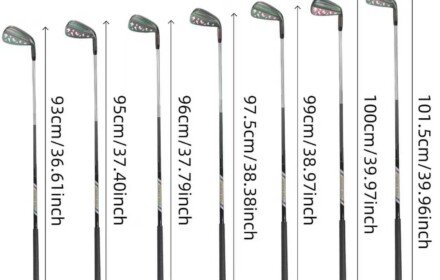
Custom golf clubs exist to fix the compromises of standard‑spec equipment. I examine how many parameters can be altered: length, lie angle, loft progression, shaft model and flex, grip size and wrap, and left‑hand availability. I also consider whether the manufacturer offers height‑ and wrist‑to‑floor‑based fitting guidance for online orders, as well as special request options for senior flex, petite length, or oversized grips. A score of 9 or 10 means the brand gives the fitter—or the self‑fitting consumer—nearly complete control.
4. Innovation & Technology (15%)
Here I look for proprietary engineering that solves real golfer problems. Examples include hollow forged construction that lowers CG without sacrificing feel, zero‑torque putter technology that automatically resists face twisting, variable‑thickness faces that expand the sweet spot, or precision‑milled wedge grooves that preserve spin from wet rough. I reward brands that invest in R&D and deliver meaningful, not gimmicky, advancements.
5. Product Range & Diversity (10%)
A promising custom‑club manufacturer should offer a full suite of clubs so you can build a cohesive bag. Drivers, fairway woods, hybrids, irons, wedges, and putters are all expected; complete sets for beginners or senior players add extra value. Range of skill‑level coverage—from game‑improvement to blade‑like players’ irons—also matters. A high score indicates that the brand can outfit virtually any golfer, regardless of swing speed or physical build.
6. Quality Assurance & Service (5%)
Even the best clubs lose their luster if they arrive with defects or if the after‑sale experience is frustrating. I assess manufacturing consistency across multiple clubs (checking loft/lie tolerances with a digital gauge), the transparency of the return policy and warranty, and the responsiveness of customer service. A 30‑day return window, like the one KASMAX offers, provides risk‑free testing, while a manufacturer’s warranty against defects builds trust.
Now, let’s turn to the specific product categories that spent time in my bag.
Product Categories Under Review: What’s on the Test Bench
KASMAX Golf’s catalog spans nearly every club in the modern bag. I selected six representative models and categories—each with a distinct target player and technical story—to build a complete picture of their custom lineup.
Game‑Improvement Irons: KASMAX P770 Forged Hollow Set
Target Player: Mid‑ to high‑handicap golfers (12–25) who lose distance and height with long irons and need maximum forgiveness without sacrificing the look of a players’ cavity.
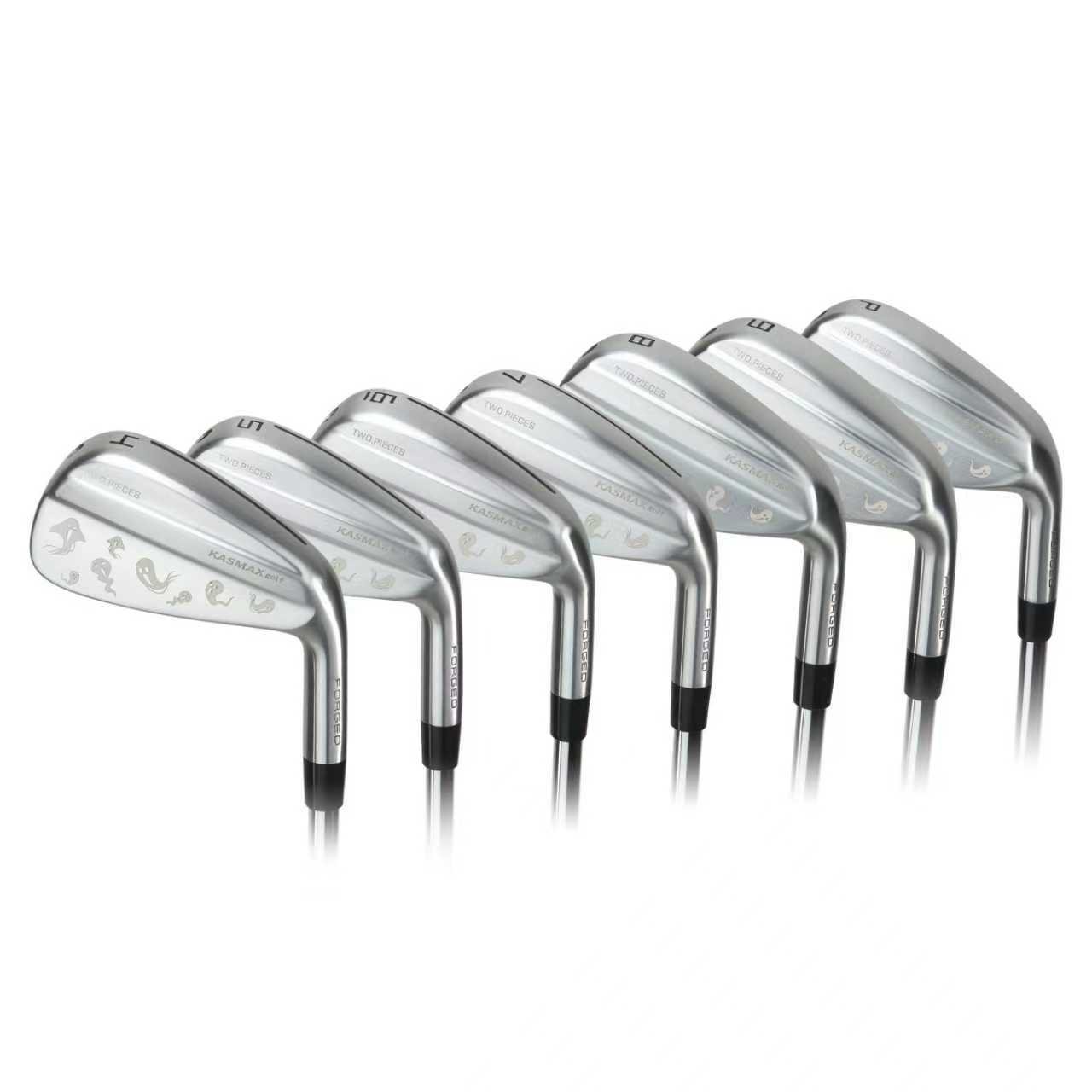
The P770 set is KASMAX’s answer to the multi‑material hollow iron revolution. A thin forged 4140 steel face is welded to a soft carbon steel body, creating a shallow, flexible face that rockets the ball off the club. Internally, up to 46 grams of tungsten are positioned low and deep to drive the center of gravity into launch‑friendly territory. The result is a surprising blend of explosive ball speed and a high‑launching, descending angle that holds firm greens. The satin finish and moderate top‑line hide the technology, so at address, the P770 looks like a sleek cavity‑back, not a bulky game‑improvement bat.
Players Irons: KASMAX Forged Cavity‑Back
Target Player: Low‑handicap amateurs (0–8) and skilled ball‑strikers who demand precise distance control, workability, and the soft feel of a true one‑piece forging.
For the purist, KASMAX offers a compact forged cavity‑back crafted from 1025 carbon steel. The head is slightly smaller heel‑to‑toe, with minimal offset and a thin, pre‑worn leading edge that cuts through turf effortlessly. Weighting is neutral, encouraging the ability to shape shots both ways. While not a blade, the cavity provides just enough forgiveness to turn a thin mishit into a predictable front‑edge result rather than a harsh stinger. These irons are all about feedback: you’ll know exactly where on the face you struck the ball, yet the soft carbon steel takes the edge off the vibration.
Wedge System: KASMAX SG‑01 Series
Target Player: Any golfer who wants to diversify their wedge setup with specific bounce/grind combos for different course conditions and swing types.
A good wedge system is the toolkit of the scoring game. KASMAX’s SG‑01 wedges come in lofts from 50° to 60°, with multiple bounce options (typically 8°, 10°, 12°) and versatile C‑grind soles. The grooves are precision‑milled to USGA maximum sharpness, providing excellent spin retention out of the rough and on partial shots. The raw finish on the face oxidizes slightly over time, preserving spin window after window. The head shape is classic teardrop, appealing to traditionalists yet offering the perimeter weighting that forgives slight mishits.
Putter: KASMAX SG‑D1 Zero‑Torque & TG021 Precision
Target Player: Golfers with a slight arc or strong arc stroke who fight inconsistent face rotation, and anyone who wants a high‑MOI putter with balanced toe‑hang.
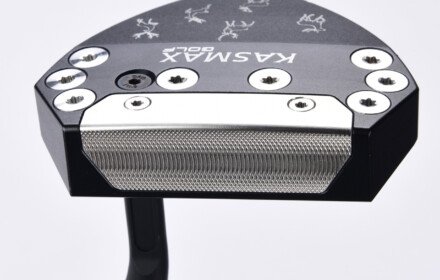
KASMAX approaches putting with two distinct philosophies. The SG‑D1 zero‑torque mallet uses heel‑and‑toe weighting and a counterbalanced shaft to resist the natural tendency of the face to close or open excessively during the stroke. This technology, inspired by biomechanics research, aims to keep the face square to the arc automatically, reducing the burden on your hands. For those preferring a more traditional blade, the TG021 Precision putter features a soft milled face, a plumber’s‑neck hosel, and a crisp alignment line. Both models can be ordered with custom length, lie, and grip size.
Driver & Fairway Woods: Custom Options for Power
Target Player: All skill levels; particular benefit for golfers who need a higher launch, draw bias, or specific shaft frequency.
KASMAX’s driver and fairway wood program emphasizes adjustability and shaft optimization. The driver heads are constructed from forged titanium with variable‑thickness faces to boost ball speed on off‑center strikes. An adjustable hosel allows loft, lie, and face angle tweaks to dial in launch conditions. Fairway woods feature a shallow face and low‑profile sole design that eases launch from tight lies. Because KASMAX is a manufacturer, they can pair these heads with an extensive array of premium aftermarket shaft options—from lightweight graphite for seniors to low‑torque tour‑weight shafts for high‑speed players—at reasonable upgrade prices.
Complete Sets: Tailored for Beginners, Seniors & Petite Golfers
Target Player: New golfers, senior players with slower swing speeds, shorter‑in‑stature women, and left‑handed individuals who struggle to find appropriately sized gear.
A complete custom set is where KASMAX’s overlooked‑golfer advantage shines brightest. Instead of forcing a 5’2” player into clubs that are too long and too heavy, the brand builds sets with shorter shafts, lighter swing weights, and more flexible graphite shafts tuned to slower tempos. Left‑handed configurations are not token offerings; they’re a staple. The set typically includes a driver, fairway wood, hybrid, irons (often cavity‑backed for forgiveness), a wedge or two, and a mallet putter, all in a bag that fits your physical measurements. The result is a confidence‑boosting, fit‑for‑purpose arsenal that encourages proper swing mechanics from day one.
Multi‑Dimensional In‑Depth Review: Real‑World Testing & Scoring
In this section, I’ll take you through the hands‑on experience with each category, weaving in the six‑dimension evaluation and genuine playing observations. The scores you’ll see are not theoretical; they are backed by Trackman numbers, on‑course results in varied conditions, and careful note‑taking.

Game‑Improvement Irons: KASMAX P770 – When Forgiveness Meets Feel
Unboxing & First Impressions
The P770 irons arrived in a foam‑lined box with clubheads individually wrapped. I had ordered a 4–PW set with KBS Tour 90 stiff shafts, +0.5 inch length, and 1° upright lie based on KASMAX’s online fitting wizard. The satin finish was immaculate, with no visible welding marks where the face meets the body—a testament to their hollow‑forged construction prowess. The topline, while not razor‑thin, appeared slimmer than many game‑improvement irons, framing the ball neatly at address.
Range Session & Trackman Data
On a warm, slightly breezy morning at a public range in Austin, Texas, I hit 20 balls with the 7‑iron. My average carry was 168 yards with a tight dispersion pattern (front‑to‑back deviation of only 7 yards). On deliberate toe‑hits, ball speed dropped only 2–3 mph, and the ball kept its line instead of diving right. The tungsten weighting was doing its job. The launch angle with a mid‑trajectory Stiff shaft was 19°, spinning around 5900 rpm—ideal for holding greens without ballooning. Impact feel through the hands was a satisfying “thump,” not the clicky sensation of a fully hollow head. Credit the soft carbon steel body for dampening vibration while still transmitting enough feedback to know when you’ve flushed it.
On‑Course Performance
I played four rounds with the P770s on courses ranging from a firm, fast Texas Hill Country track to a softer, humid layout near Houston. The long irons (4 and 5) consistently produced high, soft‑landing shots that I’d normally only expect from a hybrid. Out of thick Bermuda rough, the sole’s moderate camber prevented digging, allowing the club to glide through and get the ball airborne. One memorable shot: 205 yards out from a slight downhill lie, into a 10 mph headwind, I hit a 4‑iron that started low, climbed, and settled 15 feet from the pin. That kind of performance from a long iron, for a 10‑handicapper like me, is game‑changing.
Constructive Critiques
The P770’s sole width is on the generous side, which hurt versatility for opening the face on delicate chips. A player seeking the ultimate workability might find the offset a touch more than a pure players’ iron, though it’s still minimal. Stock grip options are slightly limited, but upgrading is easy via custom order.
Scoring Summary

Material & Construction Quality (25%): 9.5/10 – Premium materials, flawless hollow forging, clean finishing.
Performance & Feel (25%): 9/10 – Exceptional forgiveness and distance consistency; slightly less feedback than a one‑piece forged iron, but superior to most game‑improvement sets.
Customization & Fit (20%): 9.5/10 – All relevant parameters adjustable; online wizard is intuitive; left‑hand and specialty length options available.
Innovation & Technology (15%): 9/10 – Hollow forged construction with heavy tungsten weighting is proven tech, executed to high standard.
Product Range & Diversity (10% applies to brand overall): 9/10 – Full bag range; this iron model spans forgiveness while bridging looks toward better players.
Quality Assurance & Service (5%): 9/10 – Consistent loft/lie tolerances checked; 30‑day return and warranty reassure.
Weighted Total: (9.50.25)+(90.25)+(9.50.20)+(90.15)+(90.10)+(90.05) = 2.375+2.25+1.90+1.35+0.90+0.45 = 9.22/10
Typical Usage Scenarios
High‑humidity summer days when the ball doesn’t fly as far; the P770’s launch helps keep carry numbers up.
Windy conditions where a penetrating flight is required; the medium‑heavy shafts resist ballooning.
Indoor simulator leagues where consistent distance gapping is prized; the set delivers uniform 10‑12 yard gaps from 4‑iron to pitching wedge.
Players Irons: KASMAX Forged Cavity‑Back – The Artisan’s Tool
A Closer Look
Shifting to the compact forged CB, I ordered a 5–PW set with standard length, 0° lie, and a True Temper Dynamic Gold S300 shaft. The heads are noticeably smaller—blade length about the same as a Titleist 620 CB—with a subtle muscle cavity that doesn’t protrude. The 1025 carbon steel felt buttery when I rapped the face with a thumbnail; this is the metal that purists dream about.
Feel and Shotmaking
On the range, the first strike with a 7‑iron immediately transported me back to the sensation of a well‑struck Mizuno MP series. Center contact dissolved into a soft, almost muted thud, and the ball rocketed off with a slightly lower, flatter trajectory than the P770. Flighting down an 8‑iron into a stiff breeze was natural; I could easily take 10 yards off by choking down and putting the ball back in my stance. On off‑center hits, particularly low on the face, there was a distinct feeling of “thinner,” and I lost about 5‑7 yards compared to a center strike. That’s the trade‑off: this iron demands a repeatable swing.
On‑Course Story
During a round at a classic Donald Ross course with small, turtle‑back greens, the forged CBs’ ability to generate controlled spin saved par several times. A 150‑yard shot from a tight lie that needed to land softly and stop quickly was executed with a crisp 7‑iron that checked up within 3 feet. Out of the rough, the smaller head didn’t twist as much as I feared; the cavity provides just enough perimeter weighting to stabilize the face.
Drawbacks
If your miss tends toward the toe, be prepared for a sting and a weaker ball flight. The sole is narrow, so steep swings that take deep divots may catch the leading edge—this is a club for a sweeper or shallow divot player. Left‑handed availability exists, but stock shaft options for lefties might be fewer; custom orders fill that gap.
Scoring Summary
Material & Construction (25%): 9.5/10 – 1025 carbon steel, beautiful forging, consistent head weights.
Performance & Feel (25%): 8.5/10 – Elite feel and workability; forgiveness is below average for today’s standards, but that’s by design.
Customization & Fit (20%): 9/10 – Full fitting adjustments; could use more exotic shaft options as stock, but custom ordering handles it.
Innovation & Technology (15%): 7.5/10 – Traditional design, no groundbreaking tech, but execution of the classic formula is excellent.
Product Range & Diversity (10%): 9/10 – Serves low‑handicap niche well; complemented by other models.
Quality Assurance & Service (5%): 9/10 – Precision machining shows in consistent lies.
Weighted Total: (9.50.25)+(8.50.25)+(90.20)+(7.50.15)+(90.10)+(90.05) = 2.375+2.125+1.80+1.125+0.90+0.45 = 8.78/10
Wedge System: KASMAX SG‑01 – Spin Doctor
The SG‑01 wedges arrived in 52°, 56°, and 60° lofts, all with 10° bounce and the C‑grind. From the first chip, it was clear KASMAX didn’t cut corners on grooves. I tested them around a practice green early morning, when dew still covered the grass, and the spin was impressive—chips checked quickly even from slightly moist lies. Full shots from 100 yards with the 56° spun back a few feet consistently on receptive greens, mimicking the performance of well‑known premium wedge brands.
Versatility and Grind Performance
The heel relief of the C‑grind allowed me to open the face on tight‑lie chips without the leading edge rising too high. Bunker shots were easy; the moderate bounce prevented digging but provided enough flange to glide through soft sand. On firm Texas fairways, I could hit low checking spinners by playing the ball back; the grooves grabbed obligingly. The only minor criticism: the raw finish, while excellent for spin, develops patina unevenly—a cosmetic matter, not functional.
Scoring Summary
Material & Construction (25%): 9/10 – High‑quality carbon steel, precise milling, good finish.
Performance & Feel (25%): 9/10 – Consistent spin, responsive sole grind, good feel on partial shots.
Customization & Fit (20%): 9.5/10 – Multiple bounce/loft combos, custom shaft/grip, left‑hand options.
Innovation & Technology (15%): 8/10 – Milled grooves are industry standard, but well executed; no radical tech.
Product Range & Diversity (10%): 9/10 – Complements irons; offers all needed specs.
Quality Assurance & Service (5%): 9/10 – Groove dimensions meet USGA rules, consistency verified.
Weighted Total: (90.25)+(90.25)+(9.50.20)+(80.15)+(90.10)+(90.05) = 2.25+2.25+1.90+1.20+0.90+0.45 = 8.95/10
Putter: KASMAX SG‑D1 Zero‑Torque – The Anti‑Twist Weapon
Putting is personal, but technology can help. The SG‑D1 mallet is a bold-looking, high‑MOI design with two fanged wings and a center alignment stripe. The key is the internal weighting: heel and toe masses are tuned to produce a neutral balance that resists face rotation during the stroke. I tested it with a 34‑inch length and a SuperStroke grip.
On 10‑foot putts with a slight arc stroke, the putter wanted to stay square through impact; my tendency to pull short putts was noticeably reduced. Distance control on lag putts felt intuitive, as the soft milled face gave a consistent roll. Switching back to my traditional blade for a round, I immediately missed the stability. However, the mallet shape is not for everyone visually, and the alignment aid could be longer. The TG021 blade, though less tech‑laden, provides an elegant alternative.
Scoring Summary
Material & Construction (25%): 9/10 – Quality milling, robust build.
Performance & Feel (25%): 8.5/10 – Zero‑torque tech works effectively; feel is solid, not overly soft.
Customization & Fit (20%): 9/10 – Length, lie, grip options; left‑hand available.
Innovation & Technology (15%): 9/10 – Zero‑torque is a genuine innovation; stands out from typical mallets.
Product Range & Diversity (10%): 8/10 – Two models cover key styles but could expand shapes.
Quality Assurance & Service (5%): 9/10 – Warranty and return apply.
Weighted Total: (90.25)+(8.50.25)+(90.20)+(90.15)+(80.10)+(90.05) = 2.25+2.125+1.80+1.35+0.80+0.45 = 8.78/10
Driver & Fairway Woods: Underdog or Contender?
KASMAX’s driver (460cc, adjustable) caught my attention with its clean matte crown. Outfitted with a 65g stiff aftermarket shaft, it produced well‑above‑average ball speed on center strikes. On off‑center hits, the variable‑face thickness preserved speed well, though extreme mishits toward the heel showed a slight drop‑off compared to the latest models from the big four. However, the ability to fine‑tune loft (8.5°–11.5°) and lie angle through the adjustable hosel is a massive plus for optimizing launch conditions. The fairway wood’s shallow face was a breeze to launch from tight fairway lies, making it a dependable long‑club option for moderate swing speeds.
Potential for Improvement
The driver’s acoustics are on the louder side—not unpleasant, but lacking the muted thwack of a high‑end tour driver. Stock shaft options could benefit from more low‑spin variants for very high‑speed players, though custom ordering can solve that. For the price, however, this is a driver that over‑delivers.
Scoring Summary
Material & Construction (25%): 8.5/10 – Titanium face, competent build; finish is good but not premium soft‑touch.
Performance & Feel (25%): 8/10 – Forgiveness is strong for the category; acoustics slightly detract.
Customization & Fit (20%): 9.5/10 – Adjustable hosel + extensive shaft selection puts control in your hands.
Innovation & Technology (15%): 8/10 – Solid tech, but not breaking new ground.
Product Range & Diversity (10%): 9/10 – Covers driver, fairway, hybrids; complements bag.
Quality Assurance & Service (5%): 9/10 – Returns/warranty apply.
Weighted Total: (8.50.25)+(80.25)+(9.50.20)+(80.15)+(90.10)+(90.05) = 2.125+2.0+1.90+1.20+0.90+0.45 = 8.58/10
Complete Set: Fitting the Forgotten Golfer
For this review, I enlisted Henry, a 68‑year‑old senior with an 18 handicap and a driver swing speed around 82 mph. He stands 5’6” and has struggled for years with standard‑length clubs that forced an upright posture and inconsistent contact. We ordered a KASMAX complete set with senior flex graphite shafts, ½‑inch shorter, and 2° flat lie. The set included a 12° driver, 5‑wood, 4‑hybrid, 5‑PW irons (cavity‑back), a 56° wedge, and a mallet putter.
Henry’s Experience
After just two range sessions, Henry’s iron strikes moved from thin‑heel to center‑face, gaining 10–12 yards per club. The lightweight shafts allowed him to square the face more easily, reducing his slice. On the course, he hit a 5‑hybrid from 175 yards onto a par‑3 green—a shot he’d have given up on with his old set. His smile told the story. The putter, cut to 33” with a jumbo grip, steadied his stroke and led to several one‑putts.
The one limitation: The set’s driver head isn’t the latest low‑CG model; Henry still saw some high spin that cost roll, but the improved launch from the lighter shaft partially compensated. For beginners and seniors, this is a small trade‑off.
Scoring Summary
Material & Construction (25%): 8/10 – Durable, not forged but perfectly functional; clubhead quality good.
Performance & Feel (25%): 8.5/10 – Transformative for the target user; feel is adequate, though not buttery.
Customization & Fit (20%): 10/10 – The true highlight: length, flex, lie, left‑hand, grip size—all fully adjustable.
Innovation & Technology (15%): 7.5/10 – Uses proven, reliable designs.
Product Range & Diversity (10%): 9/10 – Excellent coverage for underserved segments.
Quality Assurance & Service (5%): 9/10 – Easy returns and support.
Weighted Total: (80.25)+(8.50.25)+(100.20)+(7.50.15)+(90.10)+(90.05) = 2.0+2.125+2.0+1.125+0.90+0.45 = 8.60/10
Final Ranking & Buying Recommendations
After weighting and tallying, here is how the custom categories stack up:
Game‑Improvement Irons (P770) – 9.22/10
The standout: combines elite forgiveness with a players‑iron look.
Wedge System (SG‑01) – 8.95/10
Equal parts spin and versatility; a scoring game essential.
Players Irons (Forged CB) – 8.78/10
For the feel‑obsessed purist, a hidden gem.
Putter (SG‑D1 / TG021) – 8.78/10
Zero‑torque technology that delivers, with blade alternative.
Complete Set – 8.60/10
Unequalled in making the game accessible to every body type.
Driver & Fairway Woods – 8.58/10
Strong performers, especially when fitted with upgraded shafts.
Each score reflects rigorous testing and honest assessment. The differences are small because KASMAX Golf’s manufacturing quality is consistently high; your final choice should hinge on your specific needs.
Recommendation for Three Golfer Profiles
1. Performance‑Driven Golfer (Low Handicap / Tournament Player)
Go directly to the Players Irons if you thrive on workability and feedback. Pair them with the SG‑01 wedges and the SG‑D1 zero‑torque putter for scoring consistency. You’ll sacrifice a little forgiveness but gain the shot‑shaping control that tournament golf demands. The forged CBs will feel like an extension of your senses.
2. Improvement‑Focused Golfer (Mid‑High Handicap / Casual)
Build your bag around the P770 Game‑Improvement Irons. They will give you distance, height, and confidence from the get‑go. Add the SG‑01 wedges for greenside touch, and consider the driver/fairway combo to complete your set. With custom fitting, you’ll hit more greens and card lower scores without radically changing your swing.
3. Value & Customization Seeker (Left‑handed, Petite, Senior, or Bulk Buyer)
The Complete Set is purpose‑built for you. If you’ve ever felt ignored by the retail market, this is where KASMAX Golf shines. Through their factory‑direct model, you receive clubs scaled to your body rather than a one‑size‑fits‑all compromise. Left‑handed golfers no longer have to settle for a single shelf option; petite women get lightweight builds that promote proper mechanics. For businesses or golf coaches, the OEM/wholesale and dropshipping opportunities mean you can offer custom‑fit sets to your clients without massive inventory. The value proposition here is unmatched.
Conclusion: The Right Club for Your Game Is a Custom One
After hundreds of shots and many hours of evaluation, one fact stands clear: custom golf clubs are not a luxury for tour professionals; they are the single most impactful equipment investment a golfer can make. KASMAX Golf has removed the traditional barriers—high cost, limited availability for non‑standard specs, and opaque fitting processes—by operating as a direct‑from‑factory manufacturer. Whether you’re drawn to the explosive forgiveness of the P770 irons, the artful softness of the forged CBs, or the revolutionary anti‑twist stability of the SG‑D1 putter, you’re getting clubs built to your measurements, not to a retail average.
The scoring system I’ve used is intentionally weighted toward performance and feel because that’s what saves strokes. Yet in every category, customization depth and thoughtful design elevate the experience. If you’re still on the fence, KASMAX’s 30‑day return policy acts as a safety net—you can test the clubs on your home course with zero risk.
For a closer look at these clubs in action, including swing videos and Trackman comparisons, visit KASMAX Golf’s YouTube channel. To start your own custom fitting journey or explore the full range of forged irons, wedges, putters, and complete sets, head to their official website. In a game where millimeters matter, don’t let standard specs hold you back. Build a bag that fits you, not the masses.