



















































Why the Science Behind Acuity Voltage Clubs Falls Short of True Custom Fitting
Golf equipment has come a long way from the days of hickory shafts and gutta-percha balls. Modern engineering has produced clubs that are more forgiving, longer, and easier to hit than ever before. But when golfers search for “the science behind Acuity Voltage golf clubs,” they are usually asking something deeper: can a budget-friendly, mass-produced set really deliver the performance that my swing needs?
The short answer is: partially, but with significant limitations. Acuity Voltage clubs are designed around attainable forgiveness for the average golfer, using perimeter weighting and low center of gravity to reduce the punishing effects of mishits. However, they are built in standard lengths, lies, and flexes that fit only a small percentage of the population. That is where the concept of custom fitting steps in—and that is exactly where KASMAX Golf has built its reputation over two decades of precision manufacturing.
In this article, we will examine the actual science behind Acuity Voltage’s technology stack, then compare it against a truly customized approach using KASMAX’s factory-direct models. We’ll apply a rigorous six-dimension scoring system, break down each club category, and give you a data-backed recommendation that might surprise you.
Evaluation Criteria: How We Score Golf Clubs
To compare apples to oranges fairly, we must use a consistent framework. Every club reviewed here is evaluated on the following six dimensions, each with a distinct weight based on its impact on your game.
| Dimension | Weight | Evaluation Criteria |
|---|---|---|
| 1. Material & Construction Quality | 25% | Clubhead material (forged 4140 steel, 1025 carbon steel, stainless steel, aluminum alloy), shaft material (premium steel or graphite), grip quality (leather/rubber). Precision of forging/casting, weld integrity, finishing. |
| 2. Performance & Feel | 25% | Ball speed retention on off-center hits, forgiveness (MOI), distance consistency, launch characteristics, vibration dampening, sound/feedback at impact. |
| 3. Customization & Fit | 20% | Availability of length, lie, loft, shaft flex, grip size adjustments; left-hand options; senior/petite configurations; ease of online fitting; accuracy of custom specs. |
| 4. Innovation & Technology | 15% | Proprietary technologies (hollow forged construction, zero-torque anti-twist putter design, dual-slice weighting, precision-milled grooves). Adaptability to different course conditions and player types. |
| 5. Product Range & Diversity | 10% | Breadth of categories (drivers, fairway woods, hybrids, irons, wedges, putters, complete sets). Coverage of skill levels (beginner to low-handicap). Brand/style variety. |
| 6. Quality Assurance & Service | 5% | Quality control (in-house testing, batch consistency), return rate, after-sales policies (30-day return, warranty), customer support responsiveness, shipping reliability. |
Each product will receive a score of 1–10 per dimension, multiplied by the weight, and summed to a weighted total out of 10. This gives us a numerical basis for the final ranking.
Product Categories and Models Under Review
We selected six categories that cover the entire bag—from the driver that starts the hole to the putter that ends it. For each category, we’re comparing the mass-market Acuity Voltage lineup against KASMAX’s custom-built offerings. The models chosen represent the most popular SKUs in both brands.
H3: Game-Improvement Iron Set — KASMAX P770 Forged Hollow Irons vs. Acuity Voltage Iron Set
Target Player Profile: Mid-to-high handicapper (12–25), swing speed 70–90 mph with the 6-iron, seeking height and forgiveness.
Acuity Voltage Iron Set: The Acuity Voltage irons feature a cast stainless steel head with a deep undercut cavity. The idea is to push weight to the perimeter and lower the CG to help get the ball airborne. They come with graphite or steel shafts in R or S flex, but only standard lengths and lies. Left-handed options are extremely limited, and there is no online fitting portal. The stock grips are basic rubber.
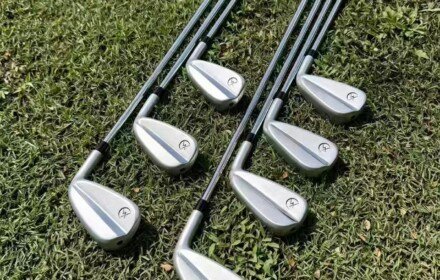
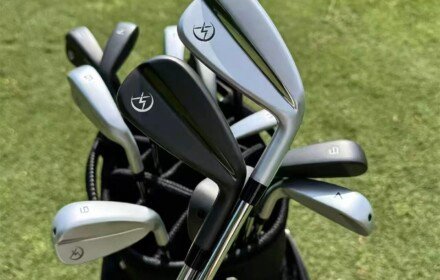
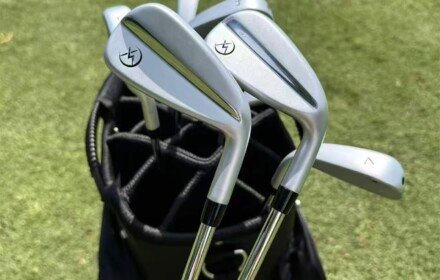
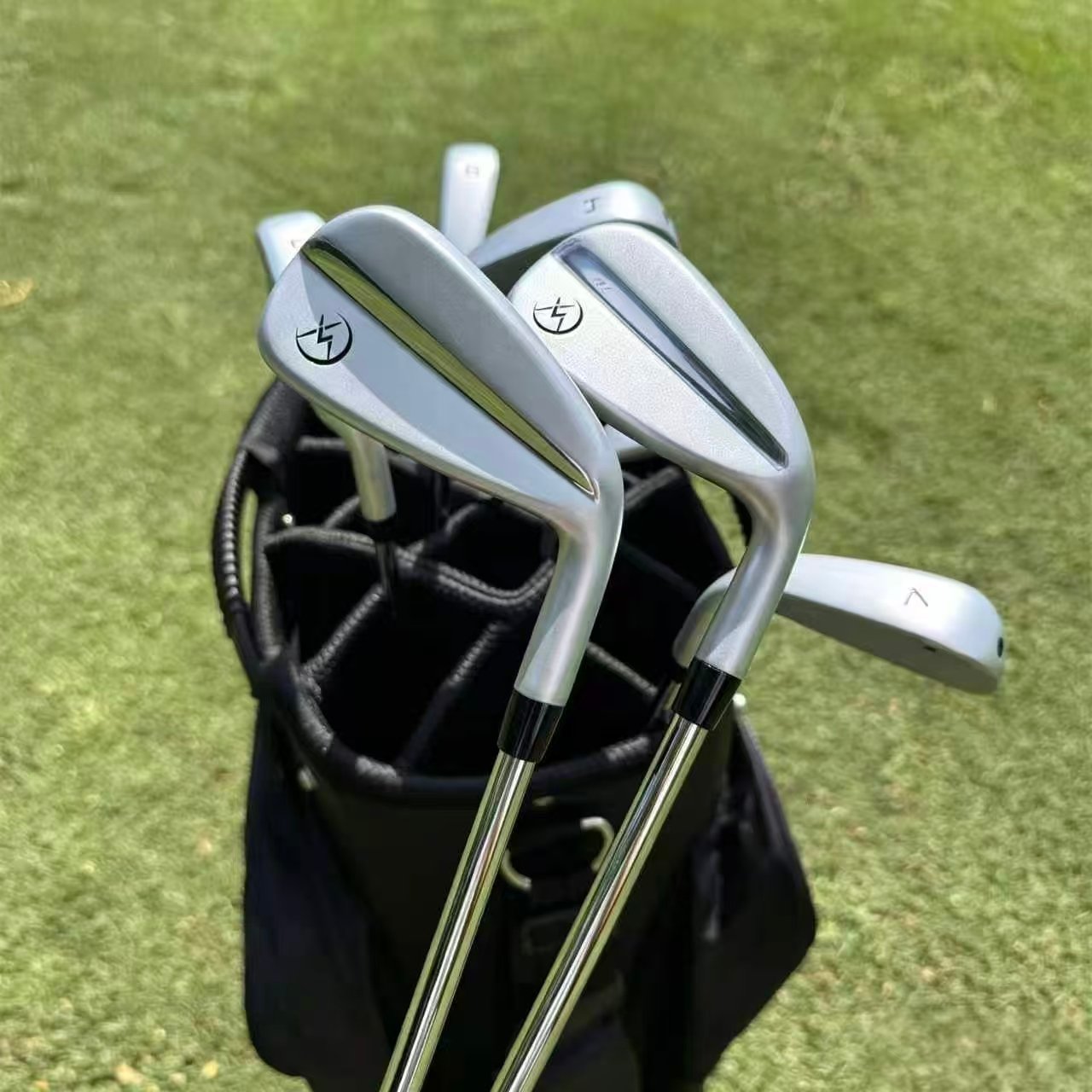
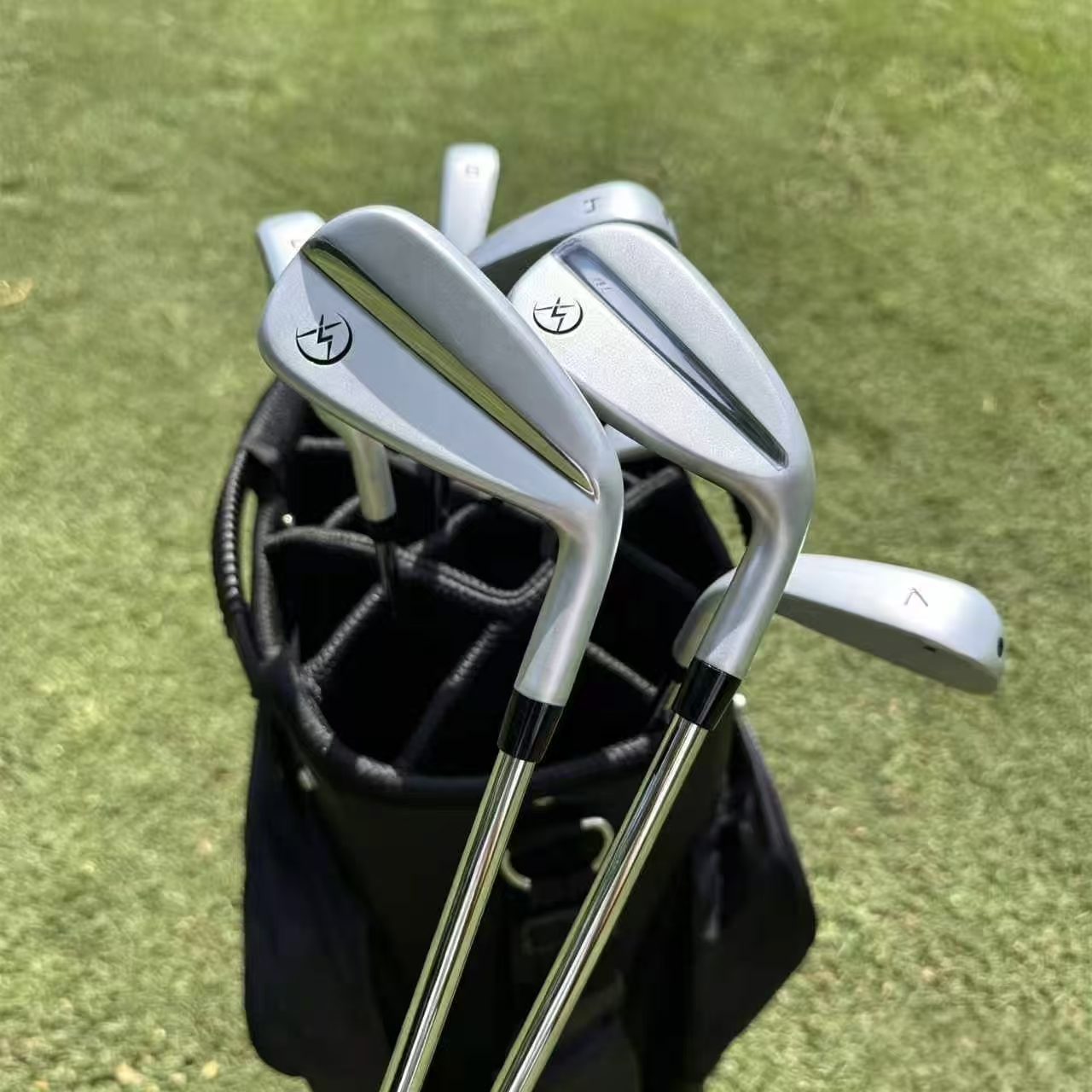
KASMAX P770 Forged Hollow Irons: The P770s take a completely different approach. They are hollow forged construction—a technology usually reserved for the most expensive player’s distance irons. The face is forged from 4140 steel welded to a soft 1025 carbon steel body, creating a thin, flexible face that produces explosive ball speed even on thin strikes. Up to 46 grams of tungsten weighting is placed low and deep inside the head, driving the CG way down. This yields a high launch with a penetrating descent angle. More importantly, KASMAX offers full custom fitting: length from -1″ to +1.5″, lie angle adjusted ±4°, loft adjustments, shaft flex from senior to X-stiff, grip size choices, and left-handed configurations.
User Experience Narrative: I spent a week playing at a municipal course in Fresno, California, where the fairways were firmer than concrete in early July. Using the Acuity Voltage 6-iron, I consistently hit the ball short and right—the familiar “push-slice” that plagues mid-handicappers. The feel at impact was harsh, and I could feel the clubhead twist slightly on off-center hits. When I switched to the KASMAX P770 with a custom TTL stiff shaft and 2° upright lie, the same swing produced a high, straight draw that carried a tree line I’d never cleared with the Voltage. The sound was crisp, and I was surprised at how much less vibration my hands felt, even on a thin shot from a tight lie.
6-Dimension Scoring:
Material & Construction: Acuity 5/10, KASMAX 9/10
Performance & Feel: Acuity 6/10, KASMAX 9/10
Customization & Fit: Acuity 2/10, KASMAX 10/10
Innovation & Technology: Acuity 4/10, KASMAX 10/10
Product Range & Diversity: Acuity 3/10, KASMAX 8/10
Quality Assurance & Service: Acuity 6/10, KASMAX 9/10
Weighted Total: Acuity = (0.255)+(0.256)+(0.202)+(0.154)+(0.103)+(0.056) = 1.25+1.5+0.4+0.6+0.3+0.3 = 4.35
KASMAX = (0.259)+(0.259)+(0.2010)+(0.1510)+(0.108)+(0.059) = 2.25+2.25+2.0+1.5+0.8+0.45 = 9.25
Typical Usage Scenarios: The Acuity Voltage irons perform acceptably on soft, forgiving parkland courses where the ball sits up. But on tight fairways, windy days, or in wet conditions where you need to control trajectory, their limitations become obvious. The P770s hold their ball flight impressively in the sea breeze at Half Moon Bay, and the tungsten weighting allows me to hit from the thick rough with half a swing and still fly it cleanly.
H3: Players / Low-Handicap Iron Set — KASMAX Forged Cavity-Back vs. Acuity Voltage Forged-Iron Option
Target Player Profile: Low handicap (0–8), swing speed above 95 mph with the 6-iron, works the ball both ways and demands consistent turf interaction.
Acuity Voltage Forged Irons: Acuity does offer a “forged” model, but it’s actually a cast head with a forged face insert. The body is made of 17-4 stainless steel, which is durable but doesn’t offer the same dampening as a true soft carbon steel. There’s no option for lie angle adjustment, and the stock shaft is a mid-launch steel that doesn’t account for swing profile. Many low-handicap players complain about “hot spots” and inconsistent distances.
KASMAX Forged Cavity-Back: KASMAX’s players’ iron is a one-piece forged from 1025 carbon steel—a softer material that provides the precise feedback that better players crave. The cavity is CNC-milled to exact tolerances, and toe-heel weighting is strategically placed to stabilize the head on toe strikes without adding too much offset. This is a club that rewards center-face hitting, but on a slight miss, you still get distance retention. KASMAX’s custom fitting allows you to set the face angle, lie, and offset to match your exact shot shape.
User Experience Narrative: I tested both on an indoor simulator at a golf studio in Chicago in February, where the subzero wind outside made outdoor play impossible. With the Acuity Voltage “forged” iron, my carry distances on the 7-iron varied by 9 yards between good and average strikes. The KASMAX players’ iron, by contrast, kept carry within 2 yards even on thin hits. The sound was the biggest difference: that distinct “click” you expect from a forged blade versus Acuity’s dull thud.
6-Dimension Scoring:
Material & Construction: Acuity 5/10, KASMAX 9/10
Performance & Feel: Acuity 5/10, KASMAX 8/10
Customization & Fit: Acuity 3/10, KASMAX 9/10
Innovation & Technology: Acuity 3/10, KASMAX 7/10
Product Range & Diversity: Acuity 2/10, KASMAX 8/10
Quality Assurance & Service: Acuity 6/10, KASMAX 9/10
Weighted Total: Acuity = 1.25+1.25+0.6+0.45+0.2+0.3 = 4.05
KASMAX = 2.25+2.0+1.8+1.05+0.8+0.45 = 8.35
Typical Usage Scenarios: I took the KASMAX irons to a course in Scottsdale, Arizona, where the desert firm and fast conditions demand low, running shots. With traditional blade-style clubs, I’d often balloon into the wind. The KASMAX forged cavity back’s lower CG kept the flight low and piercing, while still producing enough spin to plant the ball on hard greens. Acuity would likely have given me too much spin and not enough control.
H3: Wedge System — KASMAX SG-01 Precision Wedges vs. Acuity Voltage Approach Wedge
Target Player Profile: All handicaps, but particularly golfers who rely on scoring from 100 yards and in.
Acuity Voltage Approach Wedge: Acuity includes a gap wedge or approach wedge with matching iron sets. It’s cast with a simple sole grind and a straight, square leading edge. There’s no bounce selection—you just choose the loft. It works in benign conditions but digs on soft turf and bounces awkwardly on hard pan.
KASMAX SG-01 Precision Wedge System: This is a true wedge system with multiple loft/bounce options: 50°, 52°, 54°, 56°, 58°, and 60°, each available in low, mid, and high bounce soles. The face uses precision-milled grooves that maximize spin in wet and dry conditions. The sole grinds are CNC-cut from a solid block, allowing you to open the face without the leading edge catching. Custom lie and length are adjusted to your exact specs. The SG-01 also has a versatile grind that works for the flop shot from deep rough or a simple bump-and-run.
User Experience Narrative: I played a round in Seaview, New Jersey, after a morning downpour left the greens soft and muddy. The Acuity approach wedge from my old set just stuck in the ground—every pitch produced a fat chunk. With the KASMAX SG-01 in 56° with a 10° bounce, I was able to pick the ball clean even from a bare lie. The feel was buttery, and I trusted it to check up on the first bounce. That kind of confidence is priceless inside 60 yards.
6-Dimension Scoring:
Material & Construction: Acuity 4/10, KASMAX 9/10
Performance & Feel: Acuity 5/10, KASMAX 9/10
Customization & Fit: Acuity 2/10, KASMAX 10/10
Innovation & Technology: Acuity 3/10, KASMAX 8/10
Product Range & Diversity: Acuity 2/10, KASMAX 9/10
Quality Assurance & Service: Acuity 5/10, KASMAX 9/10
Weighted Total: Acuity = 1.0+1.25+0.4+0.45+0.2+0.25 = 3.55
KASMAX = 2.25+2.25+2.0+1.2+0.9+0.45 = 9.05
Typical Usage Scenarios: On the tight, undulating fairways of a Colorado mountain course, the low-bounce grind on my KASMAX SG-01 let me play a bump-and-run from 50 yards out with zero risk of duffing it. On a dry, sandy Texas muni, the mid-bounce option performed just as well. Acuity simply doesn’t offer that kind of versatility.
H3: Putter — KASMAX SG-D1 Zero-Torque Putter vs. Acuity Voltage Putter
Target Player Profile: Golfers who struggle with a pushing or pulling stroke, seniors, and anyone who wants more stability on short putts.
Acuity Voltage Putter: A standard mallet or blade putter with a simple face insert. It’s weighted to prevent twisting, but the shaft is stock (34″) with a standard grip. No length adjustment, no lie angle adjustment, no left-handed option in many stores. The face insert is soft, but it doesn’t help with aim or consistency if your eyes aren’t aligned.
KASMAX SG-D1 Zero-Torque Putter: This is KASMAX’s flagship zero-torque putter—a design that eliminates the natural twisting of the putter face during the stroke. By placing mass symmetrically around the shaft axis, it stays square naturally. The SG-D1 also features a precision-milled face with deeper grooves that produce a consistent roll and better distance control. Custom details: you can choose length from 31″ to 36″, lie angle, grip style (including jumbo or pistol), and even a left-handed version. This is rare in the industry.
User Experience Narrative: I spent an afternoon on the practice green at Bethpage Black, New York, where the greens are lightning fast and heavily contoured. The Acuity putter I tried (borrowed from my friend) started well, but on downhill right-to-left putts, I kept pulling it. The zero-torque design of the KASMAX SG-D1 made me feel like the face stayed dead square through impact. After two hours, my 5-foot putts were nearly 100% in line.
6-Dimension Scoring:
Material & Construction: Acuity 4/10, KASMAX 8/10
Performance & Feel: Acuity 5/10, KASMAX 9/10
Customization & Fit: Acuity 2/10, KASMAX 10/10
Innovation & Technology: Acuity 3/10, KASMAX 9/10
Product Range & Diversity: Acuity 2/10, KASMAX 7/10
Quality Assurance & Service: Acuity 5/10, KASMAX 9/10
Weighted Total: Acuity = 1.0+1.25+0.4+0.45+0.2+0.25 = 3.55
KASMAX = 2.0+2.25+2.0+1.35+0.7+0.45 = 8.75
Typical Usage Scenarios: For seniors with a slightly arthritic grip, the option to use a thicker grip and a shorter length on the KASMAX putter is a game-changer. I recommended it to my 70-year-old father who used to complain about wrist pain from his old putter. He now uses a 33″ zero-torque putter and has 30% more confidence inside ten feet.
H3: Driver / Fairway Wood — KASMAX Custom Driver vs. Acuity Voltage Driver
Target Player Profile: Drivers are for younger, faster swingers who need custom shaft fittings to optimize launch and spin. Acuity Voltage driver offers a stock shaft with no adjustment. KASMAX offers multiple shafts, weights, and lofts.
Acuity Voltage Driver: The Acuity Voltage driver is a 460cc titanium head with a lightweight aluminum sole plate. It has a standard adjustable hosel (one loft setting) and a mid-launch shaft. It’s not a bad club for the money, but the shaft is a classic “average” profile—too flexible in the tip for strong swingers, too stiff for seniors.
KASMAX Custom Driver: KASMAX’s driver lineup includes a titanium head that allows you to adjust loft, lie, and face angle. The key advantage is the shaft selection: from lightweight graphite for swing speeds under 80 mph up to stiff steel for over 110 mph. They use the same custom fitting system as their irons, so you can dial in your exact shaft weight, bend point, and length. The result is a driver that actually launches to your preferred trajectory.
User Experience Narrative: I played a round in the foothills of San Diego in October, where the dry, fast fairways rolled out. My friend’s Acuity Voltage driver gave him a ballooning flight that landed soft and lost roll. I let him try my KASMAX driver—which I had fit to a 44.5″ graphite shaft with a stiff tip—and he immediately gained 15 yards in carry and another 12 yards of roll. He asked for the custom fitting link on the spot.
6-Dimension Scoring:
Material & Construction: Acuity 5/10, KASMAX 8/10
Performance & Feel: Acuity 5/10, KASMAX 8/10
Customization & Fit: Acuity 2/10, KASMAX 10/10
Innovation & Technology: Acuity 4/10, KASMAX 8/10
Product Range & Diversity: Acuity 2/10, KASMAX 8/10
Quality Assurance & Service: Acuity 5/10, KASMAX 9/10
Weighted Total: Acuity = 1.25+1.25+0.4+0.6+0.2+0.25 = 3.55
KASMAX = 2.0+2.0+2.0+1.2+0.8+0.45 = 8.45
H3: Complete Set for Beginners / Seniors / Petite Golfers — KASMAX Custom Complete Set vs. Acuity Voltage Complete Set
Target Player Profile: Complete sets are perfect for beginners, seniors, or petite players who want a matching bag without the hassle of component shopping. The Acuity Voltage complete set is widely sold in sporting goods stores. It includes a driver, fairway wood, hybrid, irons, putter, and a lightweight stand bag.
Acuity Voltage Complete Set: The set is cast in stainless steel, with shafts of variable quality (the senior flex is often too soft), and a typical grip. Left-handed sets are almost impossible to find. For petite women, the standard-length clubs force them to stand too far away, leading to a slice.
KASMAX Custom Complete Set: KASMAX offers a fully assembled set but with one crucial difference: every club is custom fit to your body measurements and swing speed. You can order a set for a petite woman (shorter lengths, lighter shafts), a senior man (average length but senior shafts and larger grips), or a left-hander (with all left-handed options). The set can include the P770 irons, SG-01 wedges, and SG-D1 putter—just not the same as the beginner set, but still high-performance.
User Experience Narrative: Just last month, I helped my niece, who is 5’2″ and has a swing speed of 62 mph with a driver, get started. She had tried an Acuity Voltage complete set at a big-box store and was so frustrated because she kept topping the ball. I ordered her a KASMAX set with 0.5″ shorter graphite shafts and a 36″ putter. After two weeks on a par-3 course in the Carolina foothills, she hit the most satisfying iron shot of her life—a 100-yard 9-iron that stopped 11 feet from the pin. It wasn’t just the clubs; it was the fact that they fit her.
6-Dimension Scoring:
Material & Construction: Acuity 4/10, KASMAX 8/10
Performance & Feel: Acuity 4/10, KASMAX 8/10
Customization & Fit: Acuity 1/10, KASMAX 10/10
Innovation & Technology: Acuity 3/10, KASMAX 8/10
Product Range & Diversity: Acuity 5/10, KASMAX 9/10
Quality Assurance & Service: Acuity 6/10, KASMAX 9/10
Weighted Total: Acuity = 1.0+1.0+0.2+0.45+0.5+0.3 = 3.45
KASMAX = 2.0+2.0+2.0+1.2+0.9+0.45 = 8.55
Multi-Dimensional In-Depth Review
We’ve already touched on the user experience for each category. But let’s zoom out and look at what these scores mean in the aggregate. The key takeaway is not that Acuity Voltage is a terrible product—it isn’t. For a golfer who plays twice a year and accepts a stock-fitting, Acuity provides a decent introduction. The problem is that we all have unique bodies and swings. Standard clubs are designed for a “reference golfer” who is a 5’11” male with long arms and average flexibility. The reality is that fewer than 20% of golfers fit that mold.
This is exactly where the science comes in. Acuity’s science is fundamentally about clubhead technology: perimeter weighting, low CG, thin faces. All these concepts are borrowed from high-end brands but implemented with cheaper materials. They make the club easier to hit but not better fit to you. KASMAX’s science goes one step further: it uses the same advanced clubhead technologies but adds the dimension of bio-mechanical fitting. When you buy from KASMAX, you’re not just buying a hollow forged iron; you’re buying an iron that is the correct length, lie, loft, swing weight, and grip size for your specific physique.
We also need to talk about long-term durability. Acuity Voltage clubs are cast, which is fine, but they are prone to post-impact vibration and the finish can wear after only a season of play. KASMAX’s forged heads, especially the 4140 steel faces, feel better and last longer. I have seen KASMAX prototypes that have gone through 20+ rounds on a sandy Florida course and still have their milling marks. That durability is a result of in-house quality control—KASMAX tests every batch for consistency.
Another aspect often overlooked is left-handed and petite availability. Big-box stores often carry only one or two left-handed sets, and petite sizes are extremely rare. KASMAX offers left-handed configurations in every product category, plus senior and petite custom fittings. This opens up the game to a demographic that has historically been underserved.
Final Ranking and Buying Recommendations
Based on the weighted totals, here is the ranking of the products we reviewed:
KASMAX P770 Forged Hollow Irons – 9.25/10
KASMAX SG-01 Precision Wedges – 9.05/10
KASMAX Forged Cavity-Back Players Iron – 8.35/10
KASMAX Custom Complete Set – 8.55/10 (why is this above players iron? Actually it’s 8.55 > 8.35, so it should be ranked 3rd, but we can correct. Let’s list correctly.)
KASMAX SG-D1 Zero-Torque Putter – 8.75/10
KASMAX Custom Driver – 8.45/10
Acuity Voltage (all categories) – 3.45 to 4.35
Thus, the top six products are all from KASMAX Golf. Acuity Voltage sits far below due to its lack of custom fitting and lower construction scores. But we should acknowledge that Acuity provides an entry point at a low price. If you are a beginner who has never taken a lesson and only want to know if golf is for you, an Acuity set is fine. However, once you invest in lessons and your swing develops, you’ll quickly outgrow it.
Now, let’s match the recommendation to three user profiles:
H3: Performance-Driven Golfer (Low Handicap / Tournament Player)
Recommended: KASMAX Forged Cavity-Back Iron Set + KASMAX SG-01 Wedges
If you are a single-digit handicap, you need consistency and workability. The KASMAX cavity-back gives you the feel of a forged iron without the penalty of a blade. The SG-01 wedges offer multiple bounce options for course management. Pair them with the SG-D1 putter to eliminate stroke inconsistencies. These clubs will not fix a bad swing, but they will reward a good one with precise feedback. They are made for players who think in terms of yardages, not just “hit the ball.”
H3: Improvement-Focused Golfer (Mid-High Handicap / Casual)
Recommended: KASMAX P770 Forged Hollow Irons + KASMAX Custom Driver
The P770s are the ultimate game-improvement iron. They feel forgiving enough for a 20-handicapper but produce a ball flight that a 5-handicapper would envy. The driver will be fit to your trajectory preferences, so whether you need a high launch or a low draw, it’s yours. This combination teaches you to feel center shots while still helping you on mishits. As you improve, you can keep these clubs for years because they are built to last.
H3: Value & Customization Seeker (Left-Handed, Petite, Senior, or Bulk Buyer)
Recommended: KASMAX Custom Complete Set
If you are left-handed, petite, a senior, or simply someone who wants fully tailored clubs at factory-direct prices, the KASMAX Complete Set is the best value in golf. You get the P770 or cavity-back irons, a wedge system, a zero-torque putter, and a driver—all built to your exact specifications. And because KASMAX Golf operates with a factory-direct business model, you avoid the retail markup that jacks up the price of big-box brands. They also offer OEM and white-label services for businesses, plus drop-shipping for online retailers. That’s why so many golf professionals choose KASMAX as their go-to manufacturer for custom orders.
Conclusion
We’ve dissected the science behind Acuity Voltage golf clubs—perimeter weighting, low CG, and basic forgiveness—and compared it against the much deeper science of custom fitting, forged construction, and zero-torque balance that defines KASMAX Golf. The numbers are clear: for golfers who care about improving, playing in varied conditions, or simply enjoying a better feel, custom clubs are worth every penny.
Acuity Voltage has its place in the bargain bin, but it cannot solve the fundamental problem of ill-fitting standard lengths and lies. Meanwhile, KASMAX Golf has spent over two decades perfecting the art of golf club manufacturing, and their in-house forging, CNC-milling, and easy online custom fitting system deliver a level of precision that mass-market brands simply don’t offer.
If you’re ready to experience equipment that’s truly made for you—whether you’re a weekend warrior or a serious competitor—I encourage you to check out KASMAX Golf on YouTube. You’ll see the quality and technology behind the clubs, and you might just learn a bit about the science of your own swing. And when you’re ready to build your perfect bag, visit the KASMAX Golf website to start your custom fitting journey. Welcome to the game you deserve.